5 Colombian New Years Superstitions

I saw 2013 in with some Colombian traditions at home.

Colombians are quite superstitious people. Magical realism isn’t just a literary style, but a part of everyday life for many of the Colombians I know. As such there are many superstitions and interpretations of omens to explain the present or predict the future. I think the strong Catholic culture provides fertile ground for the magical realism of life, especially here on the coast where time seems to operate in a different dimension.

In making plans for New Year’s Eve, I wore my good old Aussie Akubra. I planned a menu of finger food, music, mocktails and party poppers. I imagined the countdown and then the big grins and arms wrapped around friends and family while from seemingly nowhere the strains of the un-singable Auld Lang Syne wafted in. I was definitely on a different continent whilst imagining this scene.

I think the realisation I was not at home only dawned on me when it became a big deal that mi novio and D weren’t going to be at home with the family and when la suegra told me I had to go buy yellow undies. Family is a lot more important in the everyday lives of Colombians than it is for Australians. There are many dates in the calendar that are important for the family to be together, whereas in Australia, the only really important family date is Christmas. I was expected to call my family back home to wish them happy new year, although truth be told, my family would never expect a special New Year’s Eve call. For Colombians, it’s important to spend New Year’s Eve with the family and participate in an aguero (superstition or omen) or two.  Here are five superstitions I learned about in the last few days of 2012.

1. Start the new year in a state of cleanliness

While we have spring cleaning, here they go to great lengths to clean out all the cobwebs, dust the ornaments, tidy wardrobes and wash clothes before the new year ticks over. Having a clean home is a way of welcoming positive changes and having a great year free of the rubbish of the previous year. The cleaning frenzy extends all the way to cleaning the fish tank and having a good scrub in the shower.

2. You have to be awake at midnight

This might sound a little strange, but it is frowned upon as bad luck if you are caught asleep as the clock ticks over midnight. I think I’ve probably been asleep a few new year’s eves before midnight, but even though I was exhausted and there wasn’t much happening in our house this year, I had to set the alarm to wake up before midnight if I was planning on a late night siesta. Although the deafening crappy, repetitious music in the street wouldn’t have let me sleep even if I’d wanted to.

3. Eat 12 grapes at midnight and make a wish as you swallow each one

In the days leading up to 31 December, carts laden with grapes appeared in the streets so people could quickly and easily buy some grapes to complete the superstition. This tradition originated in Spain with the likely explanation that it started with grape-growers trying to sell their leftover grapes. In Spain you are supposed to swallow one at each strike of the clock at midnight. Here in Colombia it is a bit more relaxed. You have to start on the first grape as the clock ticks over and try to eat the grapes as quickly as possible, but in typical Colombian style, there isn’t a rush or sense of urgency about it. I found it helped to write down my 12 deseos (wishes) so I didn’t forget them as I was scoffing down the grapes and trying to spit the pips out; something I’ve never been any good at.

4. Hold some lentils in both hands

The lentils signify that you will be blessed with food during the year and not go hungry. At midnight you should hold a few uncooked lentils in each hand to receive this blessing. A sister-in-law told me to put a few in each pocket so as not to be caught without lentils at midnight.

Yellow undies5. Change into a new pair of yellow undies

I stared at la suegra incredulously when she told me the day before New Year’s Eve that she had to go to buy some yellow undies. It just came out of the blue and when I asked why, she said it was to bring prosperity in the new year. The idea is to slip into the new yellow knickers at midnight for the wealth to come your way, however in amongst eating 12 grapes and holding onto some lentils, this is a little difficult to do!

Now all I need to do is wait out the year to see if these little rituals work and bring me prosperity, wealth, good vibes and my 12 wishes. If these don’t work, I could always try something new from this list of 22 Latino rituals and traditions next year.

Do you have a new year’s superstition or ritual?

Travel fantasy – erased

I’m not sure when exactly I stumbled upon the fantasy of owning a hostel, but I’m pretty sure it was either on my lap of South America in 2004 or soon after when dealing with the travel come-downs back home.

I fantasised about how cool it would be to welcome foreign backpackers into my hostel and make a place where they would feel at home and where I would meet amazing people from all over the world. I would put on barbecues and have a plethora of information on activities and local sights. They would smile and share travel stories. In my fantasy it would be amazing.

Mi novio and I have just finished a 10 day stint hostel-sitting where that beautiful little fantasy was shattered. How can it be so bad in just 10 days you may ask? Well on this green grassy side of the fence I never considered the following:

* You are chained to the property. Travellers don’t have weekends off. (Actually they do, but that’s from their work or whatever, not from your property.) You need to be there all the time, and if you’re not there, you need someone trustworthy to be there. Mi novio described it as being in a cage, or rather a prison, even more apt when considering the front gate with padlock that requires opening and closing for the inmates – oops, sorry, for the guests – at all hours of the day and night.

* Utilities are essential services and when they don’t work, you’re in the bog. Here in the land of Colombia everything is possible but nothing is certain. This includes water and wifi services. When there isn’t a permanent connection to a water service and you rely on the water company to release water to fill your tanks every week and it doesn’t arrive when you have a full house of guests and the reserve tank is empty you start to panic. Same when the wifi goes on the blink or decides to be super slow and all you can hear from the guests is a bevy of complaints about the internet connection you start thinking you’ll lose them all to the competition.

* Ah yes, the competition. Taganga is pretty much chock full of hostels, guesthouses and the like for people trying to find a piece of Caribbean dream. So how is this Colombian family run hostel staffed with people who have never backpacked in their life supposed to compete with the neighbouring resort of a hostel that provides everything a traveller desires. It can’t. Like mi novio described so accurately, it is one of the little fish that always hangs around the bigger fish to feed off the leftovers. When the neighbouring hostel is full, this hostel starts to get some lodgers.

* Sex, drugs and party time. They’re carefree and miles from home, but does that mean they can leave used condoms and smoked up joints on the serene rooftop terrace? No one wants to hear 3 different couples having sex in the one night. No one wants to open the door to a guest who is having sex in the morning light in front of the hostel. They may only be here for a night or two, but this is where you live and work.

Add a 6 month old pitbull that lives in the hostel and likes to go marauding in the middle of the night, eating Christmas decorations, remote controls and ripping open bags of rubbish to spread up and down the hallway and a complete lack of reservation and accounting system and we landed in the middle of complete chaos with a bang.

After 10 days of running a hostel we realised that despite meeting some great people and feeling good about helping them with their questions about things to see and places to go, we are not cut out for this lifestyle. In the 10 days we were at the hostel mi novio spent about 3 hours one night sleeping with me, all the rest were spent in the hammock in reception ready to open the door to all the party-goers arriving back at all hours of the morning. Both of us were well and truly ready to head back to Santa Marta and sleep uninterrupted in our own bed.

One of the best things I’ve come to realise though, is that we make a great team. I bring a number of ideas to the table and mi novio is the go getter who executes them. We think along the same lines and have the same philosophies when it comes to running a business but we have different skill sets. I think any business we have and put our energies into will succeed, it’s just a matter of finding the right opportunity.

However, I am now taking my hostel fantasy, wrapping it in threadbare hostel sheets and throwing it in a big garbage bag. It’s not my problem anymore if the dog gets to it.

Do you have a travel fantasy? Has it ever turned to reality and was it as good as you imagined?

Roadtrip to Quebrada Valencia

We finally stretched the legs of our new motorbike with a day trip to the cascades at Quebrada Valencia.

With $3 worth of petrol in the tank, we headed east along the Troncal Caribe in the direction of Riohacha. I am not the best pillion passenger as I have a tendency to dig my nails in and yell into the ear of mi novio should we approach other vehicles too quickly, go over speed humps (or dead policemen as they call them here) without braking, overtake trucks or buses and I curse and scream “I don’t like this” when we weave in and out of traffic. But, after leaving Santa Marta’s city limits, we were suddenly quite alone on a well paved highway and riding under a canopy of green forest.

The air was cooler and the scenery divine. The wind blew all of the weariness and frustrations of the city away. Instead of screaming in mi novio’s ear to slow down or pay more attention, I was conversing with him, constantly exclaiming “This is so lovely.”

While I marvelled over the scenery and breathed in the fresh air (any odd insect or two), I realised that it must be quite tedious listening to me rabbit on about the scenery when he has passed by this same route thousands of times for his work but he told me that it was a completely different sensation on the motorbike where you really feel your surroundings to that of watching out the bus window.

50km and a bit over an hour later, we arrived at Quebrada Valencia, with an internationally recognised tourist attraction brown sign announcing the destination. The entrance to Quebrada Valencia is right beside the highway with a small pull-in on either side, a local store and a market stall selling aqua socks to the Colombians from the interior who can’t bear crossing the river in their sandals or bare feet.

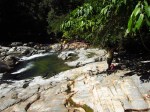
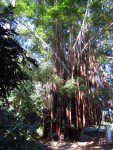
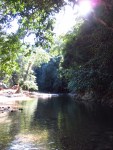
Quebrada Valencia, with its impressive range of cascading falls, is a 20 – 30 minute walk from the entrance and our first task was to cross the river. During dry season, the river is clear, shallow and tranquil, making the crossing (and subsequent crossings) quite easy. On the other side we passed by vendors selling coffee and fresh cooked arepas and walked alongside a banana plantation for a little bit. Not far into our walk we came across an enormous tree blocking the path, forcing everyone to walk around it. The tree has great clumps of root-like vines dangling down, and looks rather like you would imagine a tree relative of Mr Snuffleupagus from Sesame Street.

We continued our easy walk in the forest and crossed the river another five times to reach the lower swimming pools and rocky cascades of Quebrada Valencia.

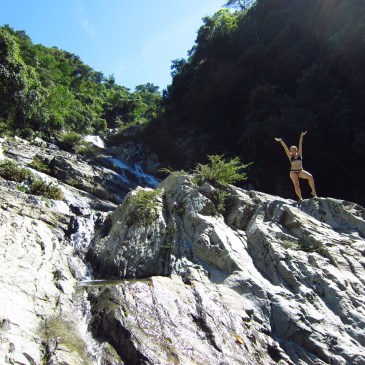
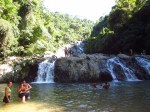
It’s a popular spot for tourists and locals who take along picnics, and even their own hammocks. The falls drop over a rocky vein that obstructs the river’s flow and creates pools at different levels and some great jumping points.

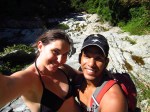
We were instantly enamoured, and climbed the rocks to find a little ledge under a shady branch to leave our belongings while taking a refreshing dip in the rock pools and a slide down rocks beaten smooth by the water current. It is a great spot to relax and unwind and enjoy the company of family and friends. I couldn’t believe when mi novio said he hadn’t been there before. Not even on a family outing with his parents or with other friends.

Further up were more water pools and great views of each waterfall and all the way down to the end of the cascades, but we couldn’t climb up to the very top as it was cordoned off with plastic ‘do not enter’ tape and had a guy posted beside to enforce the no climbing rule.

After an afternoon of bathing in the lovely rock pools, we followed the easy trail back to the entrance and our motorbike, all the while exclaiming that we will have to bring D and la suegra here one day. Quebrada Valencia really is an all-round great day trip for lovers, families and groups of friends.

~~~~~~~~~~~~~~~~~~~~~~~~~~~~~~~~~~~~~~~~~~~~~~~~~~~~~~~~~~~~~~~~~~~~~~~~~~~~~~~~~~~~~~~~~~~~~~~~~~~~~~~~~~~~

Want to go to Quebrada Valencia?

What’s there: Waterfalls, swimming and a short hike in the Sierra Nevada de Santa Marta

How to get there: Take the Troncal Caribe from Santa Marta towards Riohacha by car or motorbike (parking COP$2000 – $3000 at the entrance) or by a public bus that leaves from Calle 11 near the Mercado in Santa Marta that also passes by Parque Tayrona (ask to be dropped at Quebrada Valencia) and then flag down any return bus.

Entry fee: COP$3000 per person (US$1.65)

Hike difficulty: Easy but must be able to cross the rivers, the walking path is flat and well looked after

Walk time: 20 – 30 minutes

What to take: Sandals or flip flops, water, sunscreen, snacks or money to buy from vendors along the way, towel and camera.

Living in the Land of “No Seasons”

A case of the sun is always sunnier on the other side

Most people I know dream of chasing the sun and living in a perpetual summer. Well here I am so my life must be sweet as, right?

Unfortunately the reality isn’t quite as glamorous. The idyllic relaxed attitudes and lifestyles you encounter on a tropical holiday, are really a by-product of living a life without change. That is to say we are all more relaxed and laid-back when summer and it’s long evenings with barbecues and drinks by the pool rolls around.

I’m sure there is a tropical relative of the SADs (which is when you don’t get enough sun because of a dark and grey winter) that sends you round the bend from too much sun, day in day out (not to be confused with sunburn). I hope I don’t catch it and go troppo, which, incidentally, is the name of the Stu Lloyd book I am currently reading.

This is a great piece of blogging by a ‘neighbour’ of mine (well, we’ve never met but she’s a fellow expat who lives in the next city, which to me is good enough to warrant the title) at Transatlantic Adventure all about living in the land of no seasons. She sums it all up excellently, have a read.

Paige's avatarTransatlantic Adventure

This is the second time I’ve lived in Colombia. The second time I’ve lived in a world of “no seasons.” Because of Colombia’s latitude and longitude (in other words–it’s closeness to the equator) there is VERY little, if any, change in temperature throughout the year. Yes, there are all sorts of temperatures to be found in Colombia from the freezing peaks of la Sierra Nevada to the boiling temperatures of la Guajira and the rainforest humidity found in Leiticia to the temperate, Spring-like temperatures of Medellín, and the somewhat cooler zones of Boyacá and Cundinamarca. In fact, Colombia has so many climate zones that it is the most bio-diverse country in the world!

Valle de Cocora, Salento

Now, that being said, the temperature in a specific place doesn’t really change. In other words, in Bogotá the temperature during the day generally falls in the 60s (Farenheit) and in Barranquilla in the 90s  (Farenheit)…

View original post 1,138 more words

Making a dictionary worth its weight in words

When I was packing my bags to move to Colombia my hardcover Collins Concise Spanish Dictionary was on the yes list. Then on the maybe list. And ultimately ended up in danger of landing on the no list.

At 1.977kg on the kitchen scales it took up a decent portion of my luggage allowance. I started out adamant that it would be coming with me. I wasn’t going to buy a new you-beaut dictionary in Colombia that would cost a bomb and run the risk of not being as good (as discovered in a previous experience buying a not-to-be-trusted, inadequate dictionary in Latin America). I had also decided that my He-Man novio could do me the favour and carry it; it would be useful for him too and help to tone his muscles.

After seeing the mountain of belongings I was taking begin to grow like the local rubbish tip, I panicked about how much everything would weigh and started to think up weak reasons for not packing the dictionary.

Only at the final hour when everything was packed and weighed did I find I had both the physical space, and a spare two kilos for the behemoth. And so the dictionary joined us on our international journey and breezed through the airport check-in.

When we changed our plans mid-journey and decided to forgo our plane tickets, we suddenly had a much tighter (and stricter) weight limit to take on the bus. On our international bus trip we had to pay excess baggage, twice. Whoops! Suddenly the dictionary of my dreams was a dead weight, costing us money to keep it on the journey.

Cut to 2 months later and I’m now grateful I decided to bring the world’s weightiest dictionary with us because I’ve landed myself a gig updating some translations in a tourist guide to Santa Marta and I need to get the words right. At first I thought pobladores meant villages, but after confirming with Señor Diccionario, discovered it means settlers. It’s tricky little words like this and aledaña (outskirts) and the one I always forget destacar (to emphasise or stand out) that mean my dictionary is now worth its weight.

A fiesta!

Singing happy birthday
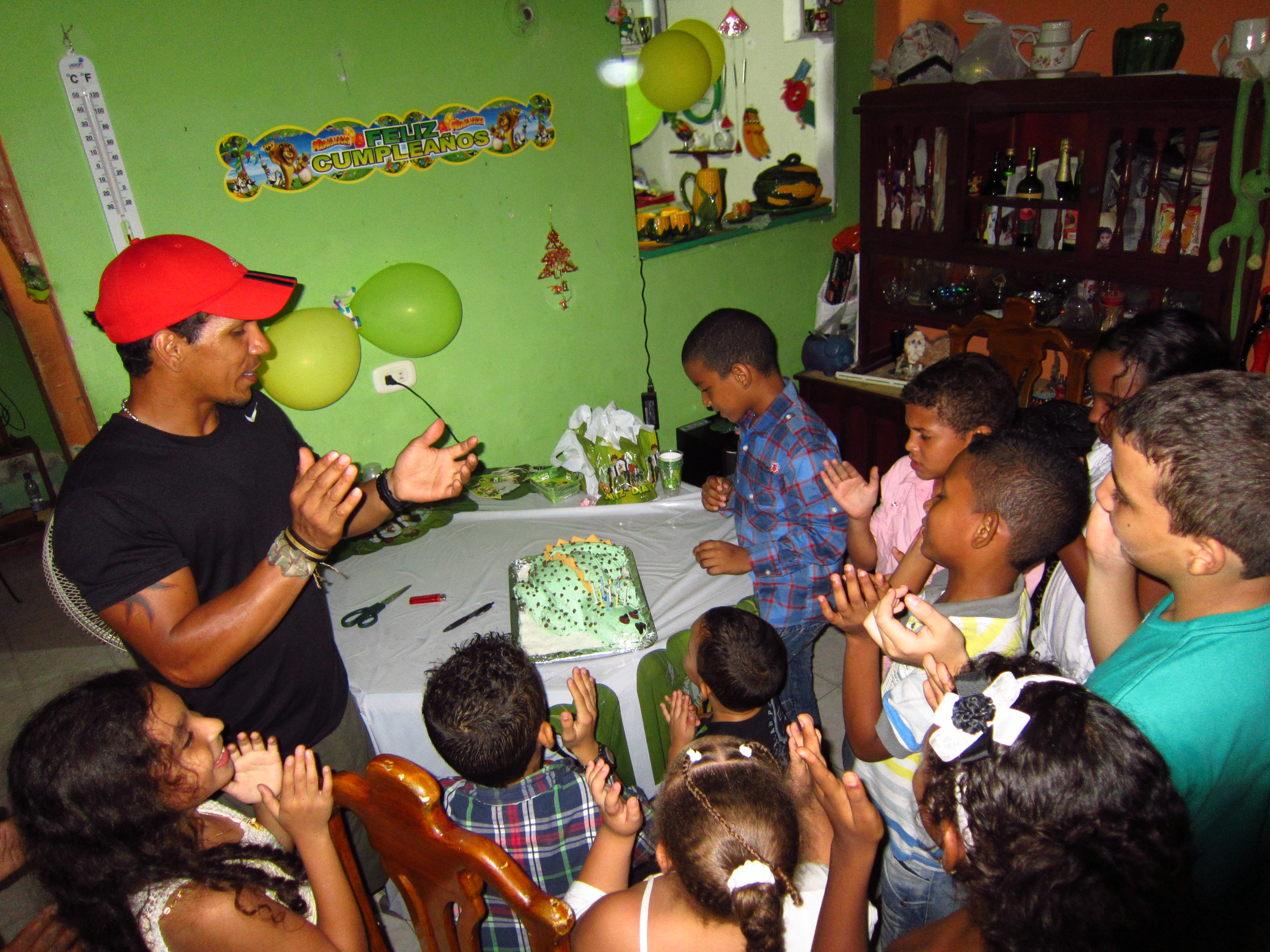
All the kids gathered around to sing happy birthday to D

When asked what he would like for his ninth birthday, a present or a party, D chose a party.

Preparations began by choosing a theme, Ben10, and trying to find all the Ben10 party paraphernalia as cheaply as possible. I’m sure the invitations, plastic cups, cake plates, lolly bags, plastic tablecloth and cardboard neckties on elastic came from some rip-off company and so were cheaper because we weren’t paying for an officially licensed product. But then again, what do a bunch of nine year olds care about royalties.

I brought to the party planning table an Australian mentality: There will be games, there will be prizes, there will be fingerfood and there will be a cake worthy of inclusion in the Australian Women’s Weekly Birthday Cake recipe book. However without having been to a kiddie birthday in Colombia before, I didn’t really have anything to benchmark against. I mean, I could throw a great party by Australian standards, but how would this hold up in Colombia?

The day before the party I was busy making jelly cups. Unfortunately they don’t have Freddo Frogs here, so they weren’t to be frogs in ponds, but just plain old ‘gelatina’ in strawberry, grape and cherry flavours. I said to mi novio “I think 25 jelly cups is enough. I mean not all of the invited kids are going to come to the party.” Mi novio replied with:

“Things are different here, the kids bring along their brothers, sisters, cousins, neighbours, whoever. All they want to do is dance and eat cake/sweets/lollies.”

Sudden panic overcame me as I did the sums. 24 invited kids x 1 sibling + 1 parent + 1 more extra just to be safe = not enough food and drink.

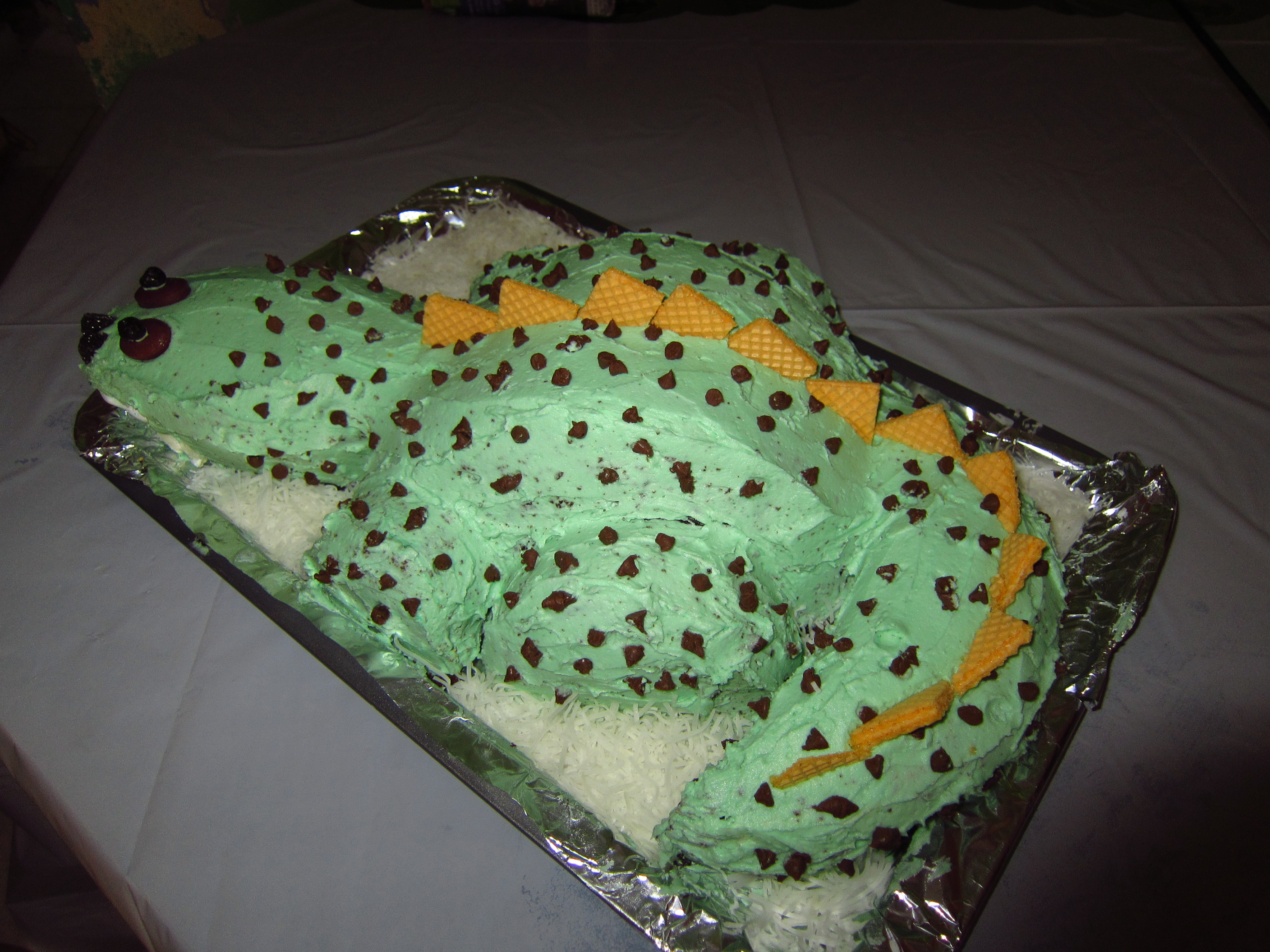
The dinosaur cake
The dinosaur cake, a winner with young and old!

We had the birthday cake (an elaborate test of my cake decorating skills dinosaur based on this plan), 25 jelly cups, little deep fried pastries with cheese inside, 7 litres of neapolitan ice-cream, 28 cupcakes and some wafer biscuits. After some dithering as to what I could make in an oven with no visible temperature markers, I decided we also needed honey joys. I hoped to goodness this would feed the hordes, I couldn’t have all these people think I was a bad hostess.

I spent the morning of the party icing the dinosaur. I have to admit I’m pretty pleased at the outcome given working in a small kitchen with no real baking tools, 30 plus degree humidity and with no proven cake sculpting skills under my belt. It also helps when practically all Colombians buy their birthday cakes from a cake shop, so the dinosaur created multiple wow factors. Wow! It’s a dinosaur! Wow! You baked it yourself! Wow! It tastes great!

Mi novio spent the afternoon blowing up balloons with the help of D, his cousin and his friends in the street and la suegra spent the afternoon putting away her precious ornaments.

At four o’clock the hour of the party arrived. Yet no guests arrived. Half an hour later and the sole guest was one of D’s best buddies from two doors down. As five o’clock started to come around, the house started to fill with kids and relatives. Mi novio and I were busy in the kitchen pouring cups of soft drink and sending out platters of cakes and jelly cups. No sooner had I arrived back in the kitchen would a child come up and hand me their finished cup/plate/spoon, only to be followed by all the other party goers. Whilst their tidiness was to be admired on one hand, the other (busy hand) was wishing they would just leave it under their chair to be collected later so they could stop interrupting us!

In an attempt to get the party revved up, mi novio wanted to commence with the games. So we played musical chairs, and then while he dashed off to the supermarket for serviettes and apples, he told me to start dancing to liven up the party and get the kids dancing. I succeeded in getting the 3 year old nephew to dance, but all the other kids looked at me awkwardly. So I retreated to the kitchen to make my honey joys.

The tiny kitchen was overflowing with used cups and spoons, trays, ingredients for honey joys and 600ml blocks of ice. The music was throbbing at the typical Colombian ‘nobody needs to hear anyone talk’ level and my feet hurt. Was it time to cut the cake yet?

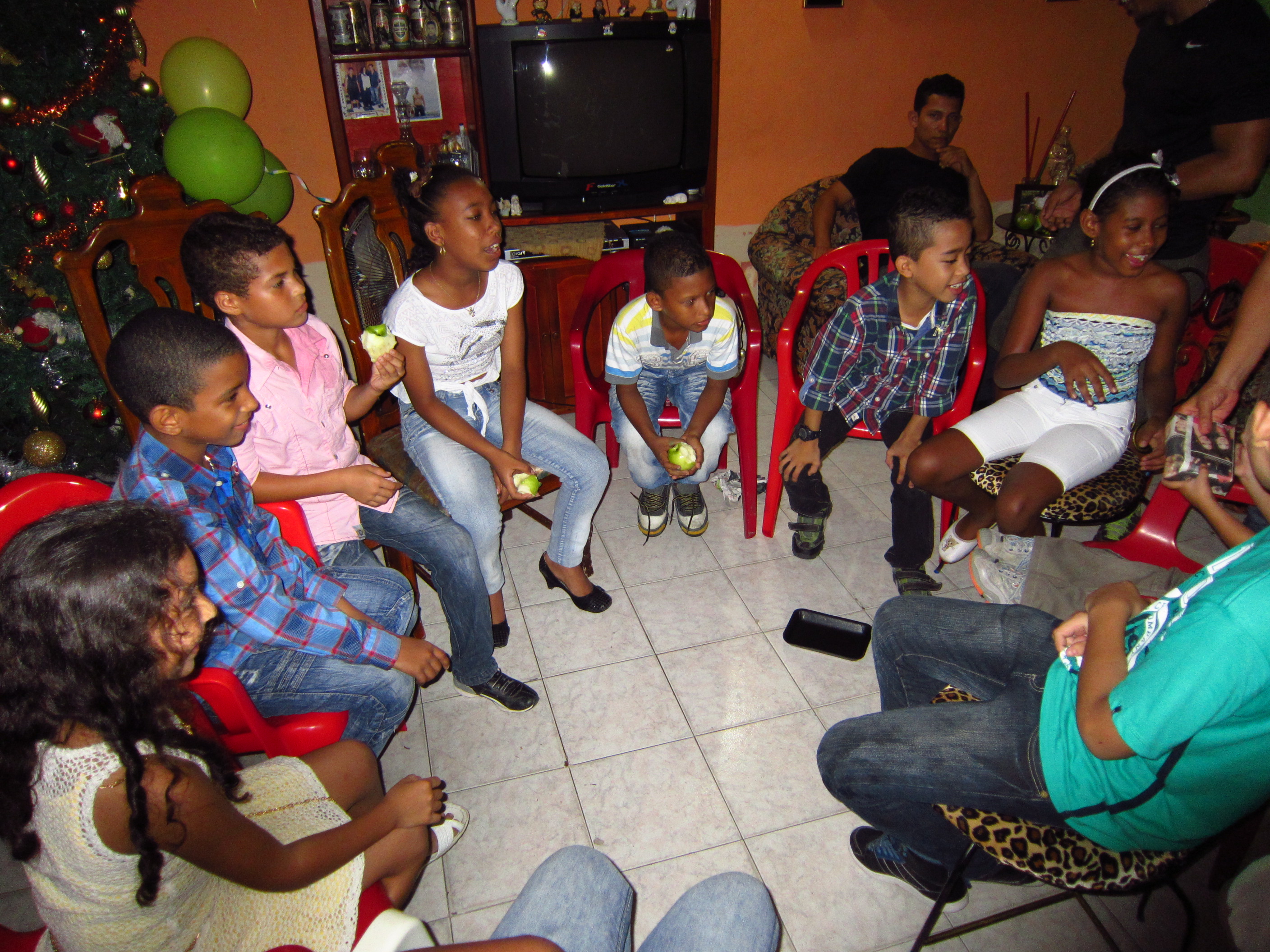
But no, we still had to play the other games. Despite never having played, or even seen it played in real life, I had decided an apple bob would be fun. Because it was raining outside we had the tub of water on a chair inside and each kid had a turn at pulling an apple out with their teeth. I had underestimated how popular this would be with the kids, even with 12 year old girls. They relished the challenge and it was insanely hilarious to see their heads bobbing about and their faces come out dripping wet! Note to self, this is a game we can play again.

Playing pass the parcel
The kids playing pass-the-parcel, they’d never played it before.

After pass-the-parcel where D started to sulk because the parcel never stopped for him to open a layer, we moved on to the cake and happy birthday. I should have remembered from last year that I would need to brush up my birthday singing in Spanish, however I overlooked this detail. The Spanish version of Happy Birthday they sing here seems different to that which I learned in Spanish classes. So I just smiled and murmured and took photos.

With the birthday cake dished out, the party started to grind to a halt, and mi novio and I could breathe a sigh of relief, pour ourselves a soft drink and eat a left over jelly cup. I had been petrified that a zillion kids would come, but there were only about 13. Most of D’s friends from school didn’t show up. I think if they did, it would have been chaos!

D went to bed happy, full of sugar and with lots of new clothes given to him by his guests.

And I went to bed thinking that at the next Colombian party we throw, we need to have ample drink and ice and just make sure we feed our guests as soon as they arrive. That, I think, is the key to a successful Colombian fiesta.

Bedtime for young boys

Recently la suegra (my boyfriend’s mother) went to visit her daughter in another town. This prompted the question from my boyfriend’s nearly nine year old son “Who am I going to sleep with?”

D has shared a bed with his grandmother since he was three and came to live with his dad. D also shared this bed with his aunt until she married and moved away. For him, having his own bed, let alone a room to himself, was not something he was used to.

D had devised all sorts of sleeping arrangements that revolved around him not having to sleep by himself and most often left mi novio and I in different beds. However, we were firm. He would be sleeping by himself until his grandmother returned.

The first night, as I enforced a 9:30pm bedtime, there were tears. He sat in the chair, crumpled and crying about having to sleep on his own. When I asked where he thought he would sleep when he’s 16 he replied “With my grandmother” and again when he’s 20 apparently he will still be sharing a room with his grandmother! Trying a different tack I asked him where he sleeps when he goes to visit his mother and he said “With my grandmother.” I couldn’t help but feel sorry for him always sharing a room with his grandmother as I remember sharing with my brother and sister at his age and itching for my own room.

Finally, due to the sternness of his father we got D to bed. We moved in a lamp from our room so he wouldn’t have to sleep in the dark and removed the doll which stared down at him from above the cupboard with a ghoulish smile. Mi novio promised he would stay with him until he went to sleep and that he only had to tap on our door if he needed us during the night.

Mi novio kept checking on D during the night and then got up to his calls at about 5am that he was cold. In the morning when asked, D said he had slept fine. No problemo! Each night thereafter followed the pattern of mi novio waiting with D until he fell asleep and there were no more tears at bedtime.

A week later, la suegra arrived and the first thing D said was “Grandmother, you’re back! Now I don’t have to sleep on my own!”

We have transport!

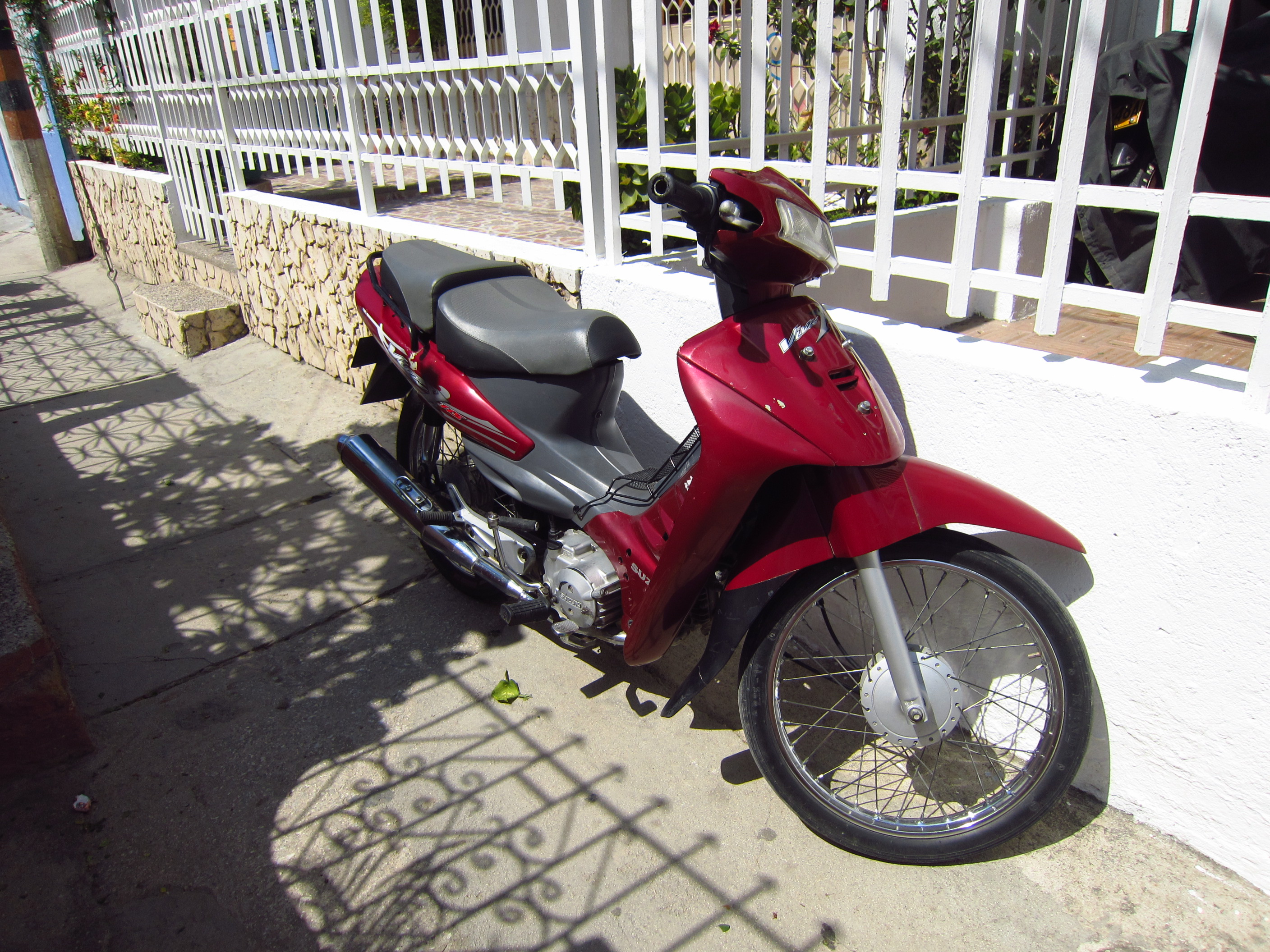
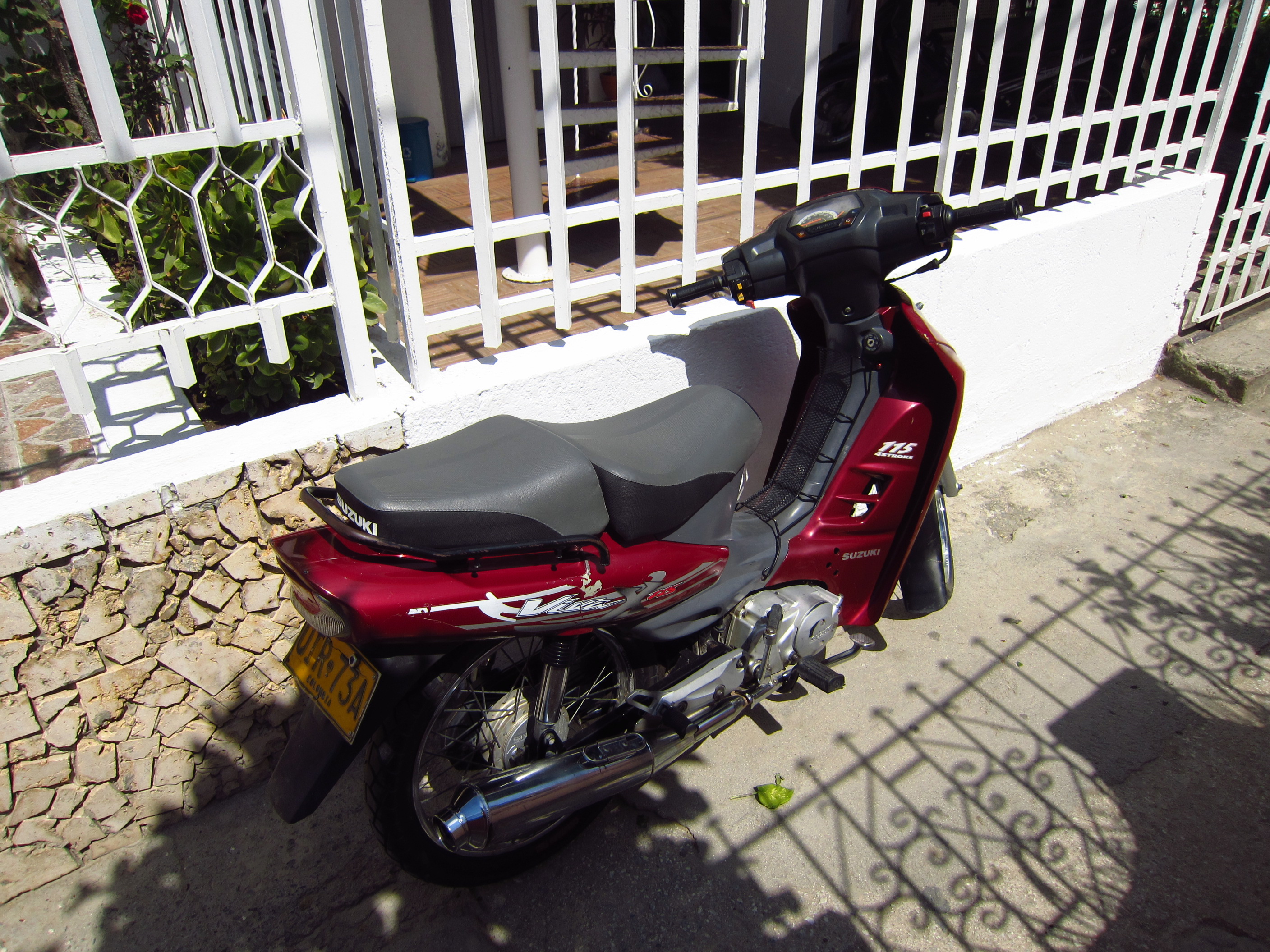
Our new motorbike
Red goes faster, but this colour in Spanish is ‘vino tinto’ or red wine. Let’s hope that means it’s a little more mellow than fast!

In Santa Marta there are more motorbikes than cars. As seems to be the case in many tropical areas of developing countries, the motorbike is the most prevalent mode of transportation.

Today mi novio and I join the ranks of transport owners after buying a second-hand Suzuki motorbike, or as I’m accustomed to calling it, a scooter.

Coming from a country where the majority of people have a car to a place where the most common forms of transport are buses, taxis and mototaxis (motorbike taxis) has been an interesting change. Not everyone here has their own transport and it is still a dream for many people to have a motorbike and even more so, a car. I’ve come to realise how important transport, and lack of transport, is to lifestyle and culture. For many families even a local bus fare stretches the budget very tight.

I can’t count the number of times I took for granted popping to the supermarket or shops only to come home with a heavy load of groceries or a armfuls of shopping bags. That was when I had a car to haul my goods. Going to the supermarket here for a ‘big shop’ to stock up on bulky and big essentials such as washing powder, sugar and rice means having to pay a taxi fare to get home as it’s too far to walk carrying plastic shopping bags. The taxi fare is dirt cheap by Western standards, but constitutes a fifth of the daily minimum wage. No wonder the vast majority of families sh0p daily at their local corner store, buying only the quantities necessary for the day.

Our new motorbike
Our new motorbike, yet to be named…

Having a motorbike now means we have freedom. We can go to the beach without having to catch two buses. We can look for an apartment. We can visit family and friends (when I make some!) and we can go to the supermarket without having to take a taxi.

Mi novio has such a big smile on his face today. He’s so excited to have a motorbike and our own mode of transport. I’ll still use the bus regularly to get to the city centre because it is

convenient, but I’m looking forward to discovering more of Santa Marta from the back of the motorbike.

A Scary Colombian Halloween

Today is Halloween, which is celebrated here in Colombia.

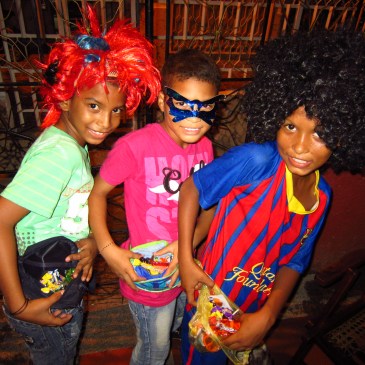
When mi novio and I went to buy lollies there were lots of little kids fully decked out in costumes looking cute, but my experience at giving out the lollies was far scarier than 3 year olds in bee costumes.

I was excited when the first kids came our front gate and so went out into the street to give them some lollies. Suddenly I was swamped by a group of about 20 kids, mostly obnoxious boys not wearing any costume or mask. They all put their hands out at me and shouted at me to give them lollies. I was overwhelmed, and told them there was enough for everyone but they had to wait their turn.

This seemed to rile them and they pushed and shoved and bullied and shouted and grabbed. I had my camera in one hand because I wanted to take a photo of the costumed kids but as the situation got more and more out of control, I called to mi novio and handed him the camera over the fence. As I did this, one kid started tickling my decidedly sweaty armpit to make me drop something and others tried to snatch the bag of lollies.

Feeling beaten, I retreated back behind the fence and started castigating the kids about being so disgustingly rude and disrespectful. It seems my Spanish is up to the task as they words flowed from me. Still they yelled and bullied with their hands between the rails and I had to give them lollies to go away.

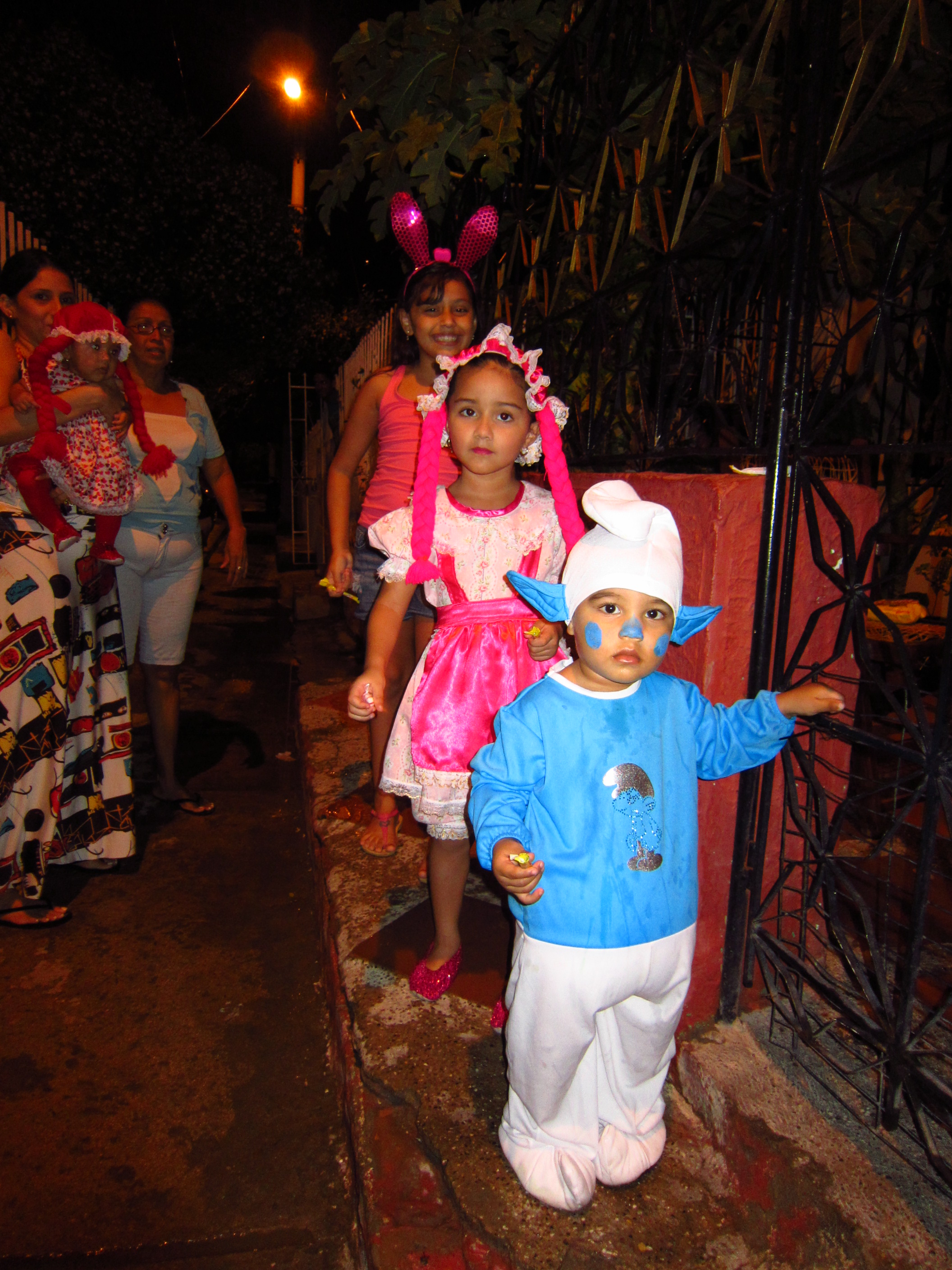
Trick or treaters in the street
Cute little trick or treaters!

That was not how I imagined my Halloween experience. I had envisioned small groups of children who I could brainwash with environmental messages “Don’t throw the wrapper on the ground, put it in the bin”, but instead it got out of hand beyond all control and I was beaten by a group of kids.

Rubbing salt into my wounds, the kids then went to the house across the street (which is less than 2m from our gate) and they lined up like angels to get a lolly. It seems I have a lot to learn about kids and just have to thank my lucky stars that mi novio‘s son respects me and what I say.

Anyways, my evening was made a little better when the neighbour’s tiny kids came to trick or treat. They were so cute and now I want a little smurf!

A room of our own

When we surprised everyone with our arrival, the question of where mi novio and I would sleep came up.

The solution was we would sleep in his mother’s bed with his 8 year old son (who usually shares his grandmother’s bed) and his mum would share a bed with his brother since his girlfriend (who normally lives here) was visiting her family in another city. Musical beds! This was just a solution until the following day when we would go to buy a fan so we could share mi novio‘s single bed, as without a fan sleeping is pretty rough. (Although mi novio always used to sleep without a fan!)

The next day mi novio and I bought a fan and some paint to start work on transforming the storage/junk room into our bedroom. I wish I’d taken photos of how the room looked before we moved out all the car and motorbike parts belonging to mi novio‘s brother, Christmas decorations belonging to his mother and all other odds and ends you find in the junk room. I wasn’t quite sure that mi novio‘s teeny tiny room with space only for a single bed and small shelf would fit all the stuff from the storage room, but it did.

Mi novio set to work with the promise that the room would be read for us to sleep in that night.

We’d probably left our start a bit late in the day but with the help of his mother we cleaned the room thoroughly and mi novio fixed up the holes and dents in the walls and set to painting the roof and walls. Painting is not my forte, even less so painting ceilings and the roof here is made of a kind of ceramic corrugated plasterboard which is even trickier to paint. Lucky for me mi novio is quite the painter. Apparently he can also paint fancy, swirly feature walls that only people with money have in their houses because not many people know how to do it and it is quite expensive to commission. I have never seen these types of painted walls in Australia, nor can I imagine them being popular there, so I think it must be a latino thing.

Though we ended up sleeping in his mother’s bed again because I’d been struck with a bout of gastro and had to go to bed, mi novio finished painting the room that night, two walls white and two walls orange.

Mi novio suggested laying tiles on the concrete floor, but as I was keen to give la suegra (my mother-in-law) back her bed, I just wanted to move in and start unpacking the 7 bags we brought with us. So we moved in our luggage and the single bed for starters whilst we looked to buy a bed. Our new room had a closet space that was nothing more than a cement wall and roof but it needed a rail. So my increasingly handy novio installed a rail to hang our clothes. He also fixed up a hole in the floor, replaced the wood covering the door between our room and his brother’s room, filled in and painted the holes between the roof and the wall and added a plastic concertina opening door (to save space and give us privacy since all the bedrooms just have a curtain for a door).

A couple of days later we finally bought a bedroom setting which came with two bedside tables, a chest of drawers, a mirror and little seat that fits perfectly in our room.

Finishing off the fitout of our room are an Aboriginal artwork and an Argentinian tango print that we had framed, a couple of boomerangs, a bag rail and fab jewellery board mi novio made for me.

So now we have our privacy. We have a space to call our own and somewhere to keep our things. And mi novio did all of this with the minimum of tools, a drill, spatula, hammer (that has had the head cut to a stub), electric drill, screwdriver, roller and paintbrush, saw and a plasterer’s scraper. I’m very impressed and so thankful that we have our own space to inhabit until we find our own apartment, it makes the adjustment to Colombian living so much easier.

This slideshow requires JavaScript.