When I was packing my bags to move to Colombia my hardcover Collins Concise Spanish Dictionary was on the yes list. Then on the maybe list. And ultimately ended up in danger of landing on the no list.
At 1.977kg on the kitchen scales it took up a decent portion of my luggage allowance. I started out adamant that it would be coming with me. I wasn’t going to buy a new you-beaut dictionary in Colombia that would cost a bomb and run the risk of not being as good (as discovered in a previous experience buying a not-to-be-trusted, inadequate dictionary in Latin America). I had also decided that my He-Man novio could do me the favour and carry it; it would be useful for him too and help to tone his muscles.
After seeing the mountain of belongings I was taking begin to grow like the local rubbish tip, I panicked about how much everything would weigh and started to think up weak reasons for not packing the dictionary.
Only at the final hour when everything was packed and weighed did I find I had both the physical space, and a spare two kilos for the behemoth. And so the dictionary joined us on our international journey and breezed through the airport check-in.
When we changed our plans mid-journey and decided to forgo our plane tickets, we suddenly had a much tighter (and stricter) weight limit to take on the bus. On our international bus trip we had to pay excess baggage, twice. Whoops! Suddenly the dictionary of my dreams was a dead weight, costing us money to keep it on the journey.
Cut to 2 months later and I’m now grateful I decided to bring the world’s weightiest dictionary with us because I’ve landed myself a gig updating some translations in a tourist guide to Santa Marta and I need to get the words right. At first I thought pobladores meant villages, but after confirming with Señor Diccionario, discovered it means settlers. It’s tricky little words like this and aledaña (outskirts) and the one I always forget destacar (to emphasise or stand out) that mean my dictionary is now worth its weight.
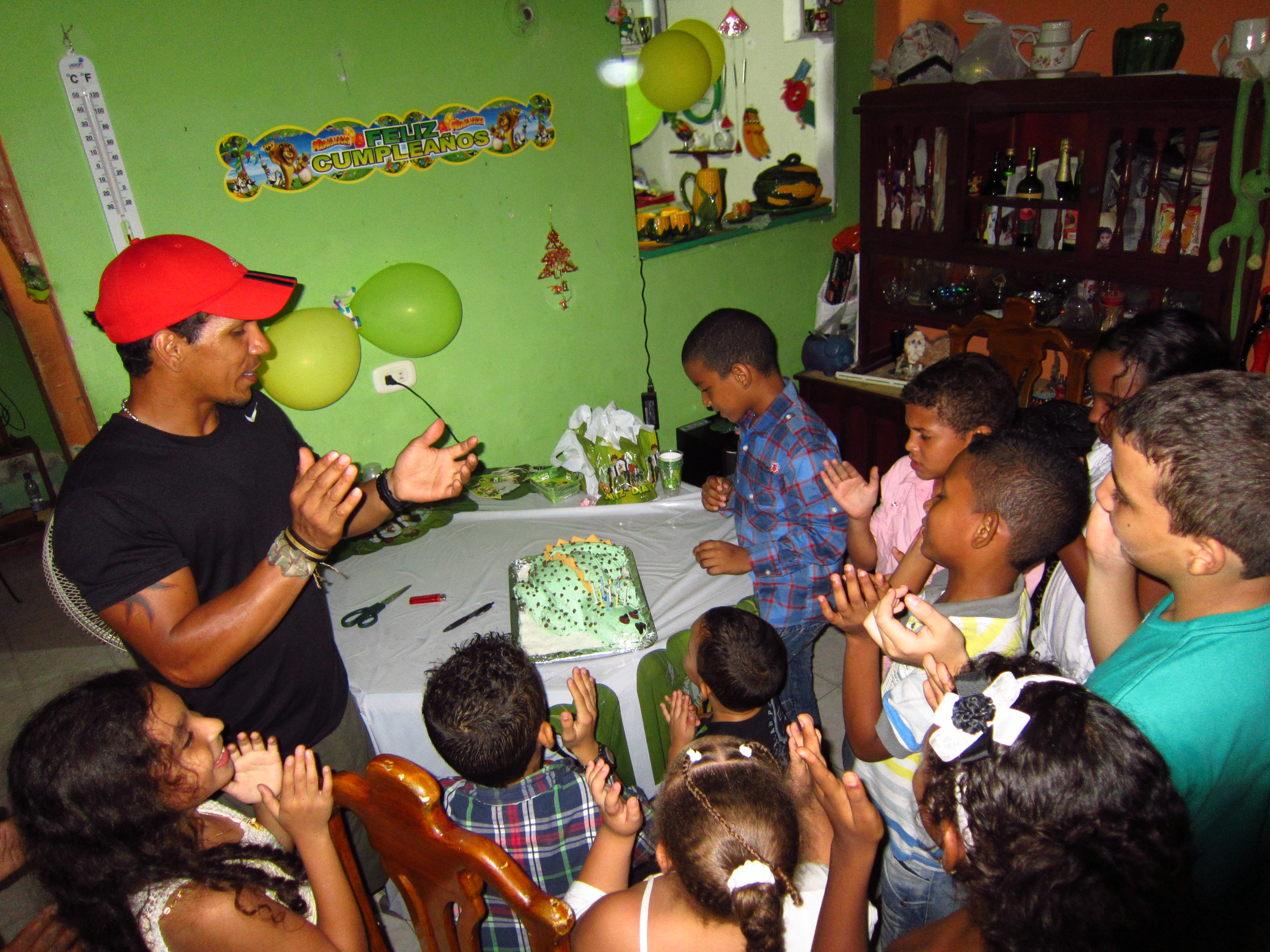
All the kids gathered around to sing happy birthday to D
When asked what he would like for his ninth birthday, a present or a party, D chose a party.
Preparations began by choosing a theme, Ben10, and trying to find all the Ben10 party paraphernalia as cheaply as possible. I’m sure the invitations, plastic cups, cake plates, lolly bags, plastic tablecloth and cardboard neckties on elastic came from some rip-off company and so were cheaper because we weren’t paying for an officially licensed product. But then again, what do a bunch of nine year olds care about royalties.
I brought to the party planning table an Australian mentality: There will be games, there will be prizes, there will be fingerfood and there will be a cake worthy of inclusion in the Australian Women’s Weekly Birthday Cake recipe book. However without having been to a kiddie birthday in Colombia before, I didn’t really have anything to benchmark against. I mean, I could throw a great party by Australian standards, but how would this hold up in Colombia?
The day before the party I was busy making jelly cups. Unfortunately they don’t have Freddo Frogs here, so they weren’t to be frogs in ponds, but just plain old ‘gelatina’ in strawberry, grape and cherry flavours. I said to mi novio “I think 25 jelly cups is enough. I mean not all of the invited kids are going to come to the party.” Mi novio replied with:
“Things are different here, the kids bring along their brothers, sisters, cousins, neighbours, whoever. All they want to do is dance and eat cake/sweets/lollies.”
Sudden panic overcame me as I did the sums. 24 invited kids x 1 sibling + 1 parent + 1 more extra just to be safe = not enough food and drink.
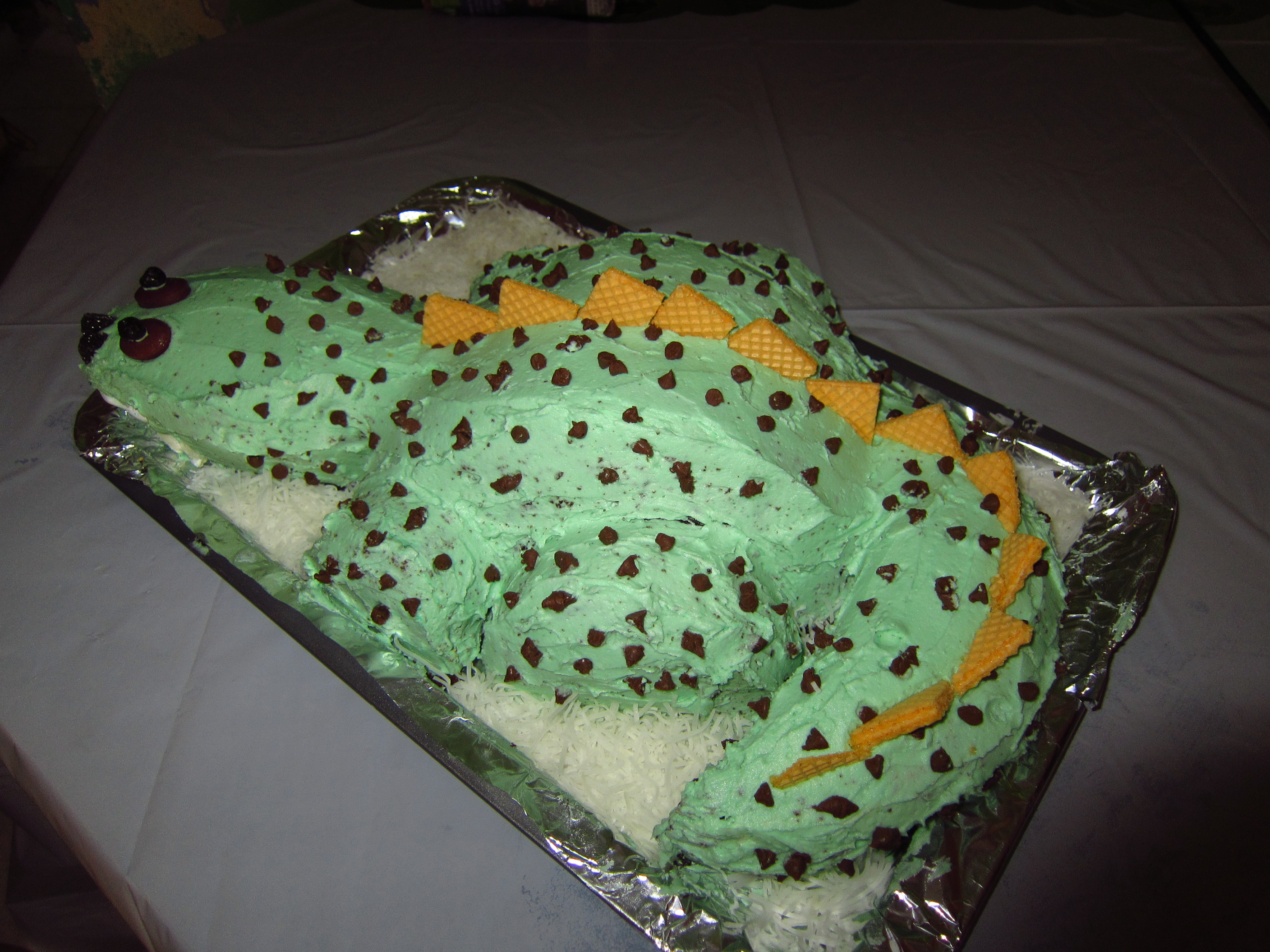
The dinosaur cake, a winner with young and old!
We had the birthday cake (an elaborate test of my cake decorating skills dinosaur based on this plan), 25 jelly cups, little deep fried pastries with cheese inside, 7 litres of neapolitan ice-cream, 28 cupcakes and some wafer biscuits. After some dithering as to what I could make in an oven with no visible temperature markers, I decided we also needed honey joys. I hoped to goodness this would feed the hordes, I couldn’t have all these people think I was a bad hostess.
I spent the morning of the party icing the dinosaur. I have to admit I’m pretty pleased at the outcome given working in a small kitchen with no real baking tools, 30 plus degree humidity and with no proven cake sculpting skills under my belt. It also helps when practically all Colombians buy their birthday cakes from a cake shop, so the dinosaur created multiple wow factors. Wow! It’s a dinosaur! Wow! You baked it yourself! Wow! It tastes great!
Mi novio spent the afternoon blowing up balloons with the help of D, his cousin and his friends in the street and la suegra spent the afternoon putting away her precious ornaments.
At four o’clock the hour of the party arrived. Yet no guests arrived. Half an hour later and the sole guest was one of D’s best buddies from two doors down. As five o’clock started to come around, the house started to fill with kids and relatives. Mi novio and I were busy in the kitchen pouring cups of soft drink and sending out platters of cakes and jelly cups. No sooner had I arrived back in the kitchen would a child come up and hand me their finished cup/plate/spoon, only to be followed by all the other party goers. Whilst their tidiness was to be admired on one hand, the other (busy hand) was wishing they would just leave it under their chair to be collected later so they could stop interrupting us!
In an attempt to get the party revved up, mi novio wanted to commence with the games. So we played musical chairs, and then while he dashed off to the supermarket for serviettes and apples, he told me to start dancing to liven up the party and get the kids dancing. I succeeded in getting the 3 year old nephew to dance, but all the other kids looked at me awkwardly. So I retreated to the kitchen to make my honey joys.
The tiny kitchen was overflowing with used cups and spoons, trays, ingredients for honey joys and 600ml blocks of ice. The music was throbbing at the typical Colombian ‘nobody needs to hear anyone talk’ level and my feet hurt. Was it time to cut the cake yet?
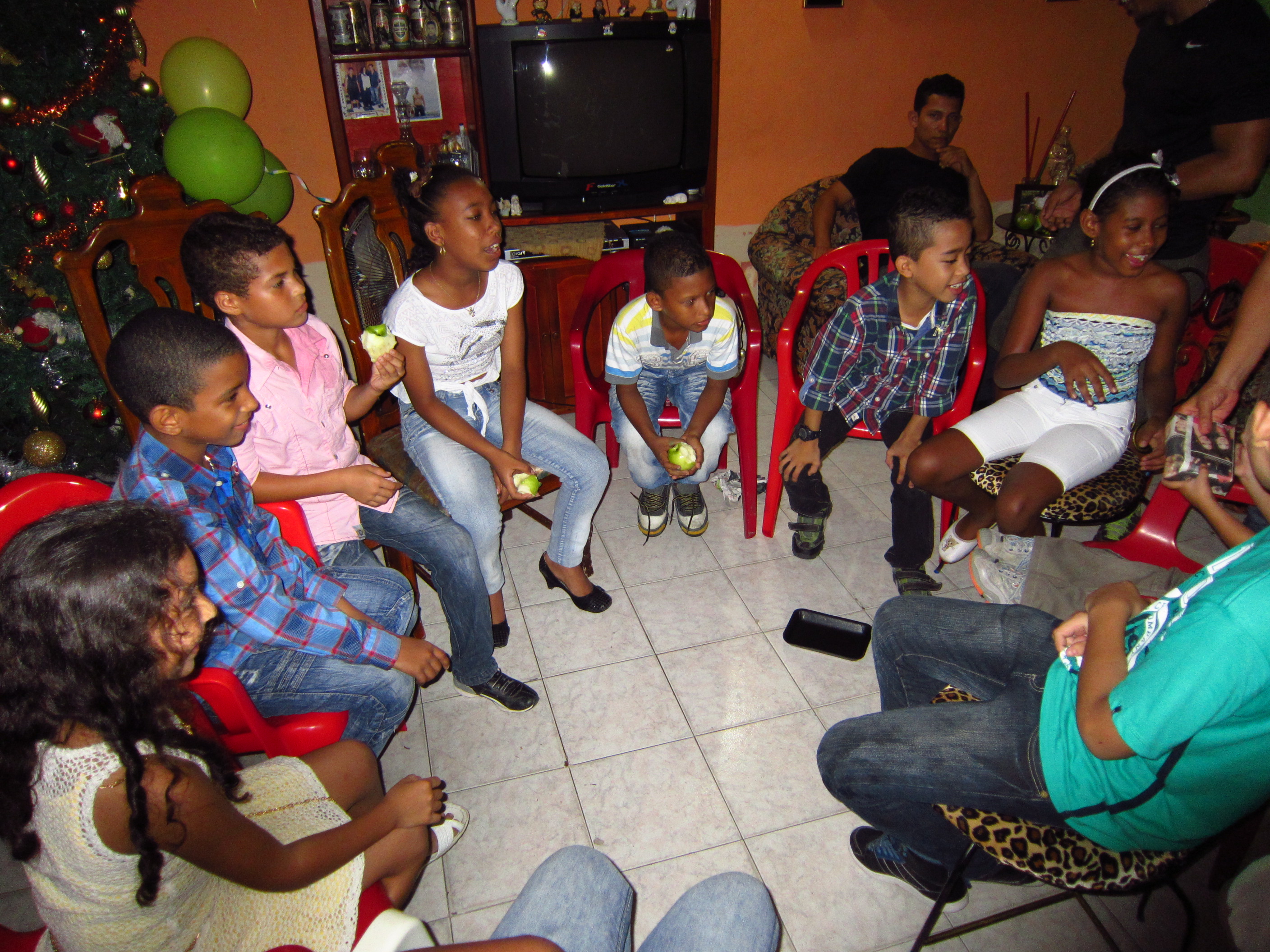
But no, we still had to play the other games. Despite never having played, or even seen it played in real life, I had decided an apple bob would be fun. Because it was raining outside we had the tub of water on a chair inside and each kid had a turn at pulling an apple out with their teeth. I had underestimated how popular this would be with the kids, even with 12 year old girls. They relished the challenge and it was insanely hilarious to see their heads bobbing about and their faces come out dripping wet! Note to self, this is a game we can play again.
The kids playing pass-the-parcel, they’d never played it before.
After pass-the-parcel where D started to sulk because the parcel never stopped for him to open a layer, we moved on to the cake and happy birthday. I should have remembered from last year that I would need to brush up my birthday singing in Spanish, however I overlooked this detail. The Spanish version of Happy Birthday they sing here seems different to that which I learned in Spanish classes. So I just smiled and murmured and took photos.
With the birthday cake dished out, the party started to grind to a halt, and mi novio and I could breathe a sigh of relief, pour ourselves a soft drink and eat a left over jelly cup. I had been petrified that a zillion kids would come, but there were only about 13. Most of D’s friends from school didn’t show up. I think if they did, it would have been chaos!
D went to bed happy, full of sugar and with lots of new clothes given to him by his guests.
And I went to bed thinking that at the next Colombian party we throw, we need to have ample drink and ice and just make sure we feed our guests as soon as they arrive. That, I think, is the key to a successful Colombian fiesta.
Recently la suegra (my boyfriend’s mother) went to visit her daughter in another town. This prompted the question from my boyfriend’s nearly nine year old son “Who am I going to sleep with?”
D has shared a bed with his grandmother since he was three and came to live with his dad. D also shared this bed with his aunt until she married and moved away. For him, having his own bed, let alone a room to himself, was not something he was used to.
D had devised all sorts of sleeping arrangements that revolved around him not having to sleep by himself and most often left mi novio and I in different beds. However, we were firm. He would be sleeping by himself until his grandmother returned.
The first night, as I enforced a 9:30pm bedtime, there were tears. He sat in the chair, crumpled and crying about having to sleep on his own. When I asked where he thought he would sleep when he’s 16 he replied “With my grandmother” and again when he’s 20 apparently he will still be sharing a room with his grandmother! Trying a different tack I asked him where he sleeps when he goes to visit his mother and he said “With my grandmother.” I couldn’t help but feel sorry for him always sharing a room with his grandmother as I remember sharing with my brother and sister at his age and itching for my own room.
Finally, due to the sternness of his father we got D to bed. We moved in a lamp from our room so he wouldn’t have to sleep in the dark and removed the doll which stared down at him from above the cupboard with a ghoulish smile. Mi novio promised he would stay with him until he went to sleep and that he only had to tap on our door if he needed us during the night.
Mi novio kept checking on D during the night and then got up to his calls at about 5am that he was cold. In the morning when asked, D said he had slept fine. No problemo! Each night thereafter followed the pattern of mi novio waiting with D until he fell asleep and there were no more tears at bedtime.
A week later, la suegra arrived and the first thing D said was “Grandmother, you’re back! Now I don’t have to sleep on my own!”
Red goes faster, but this colour in Spanish is ‘vino tinto’ or red wine. Let’s hope that means it’s a little more mellow than fast!
In Santa Marta there are more motorbikes than cars. As seems to be the case in many tropical areas of developing countries, the motorbike is the most prevalent mode of transportation.
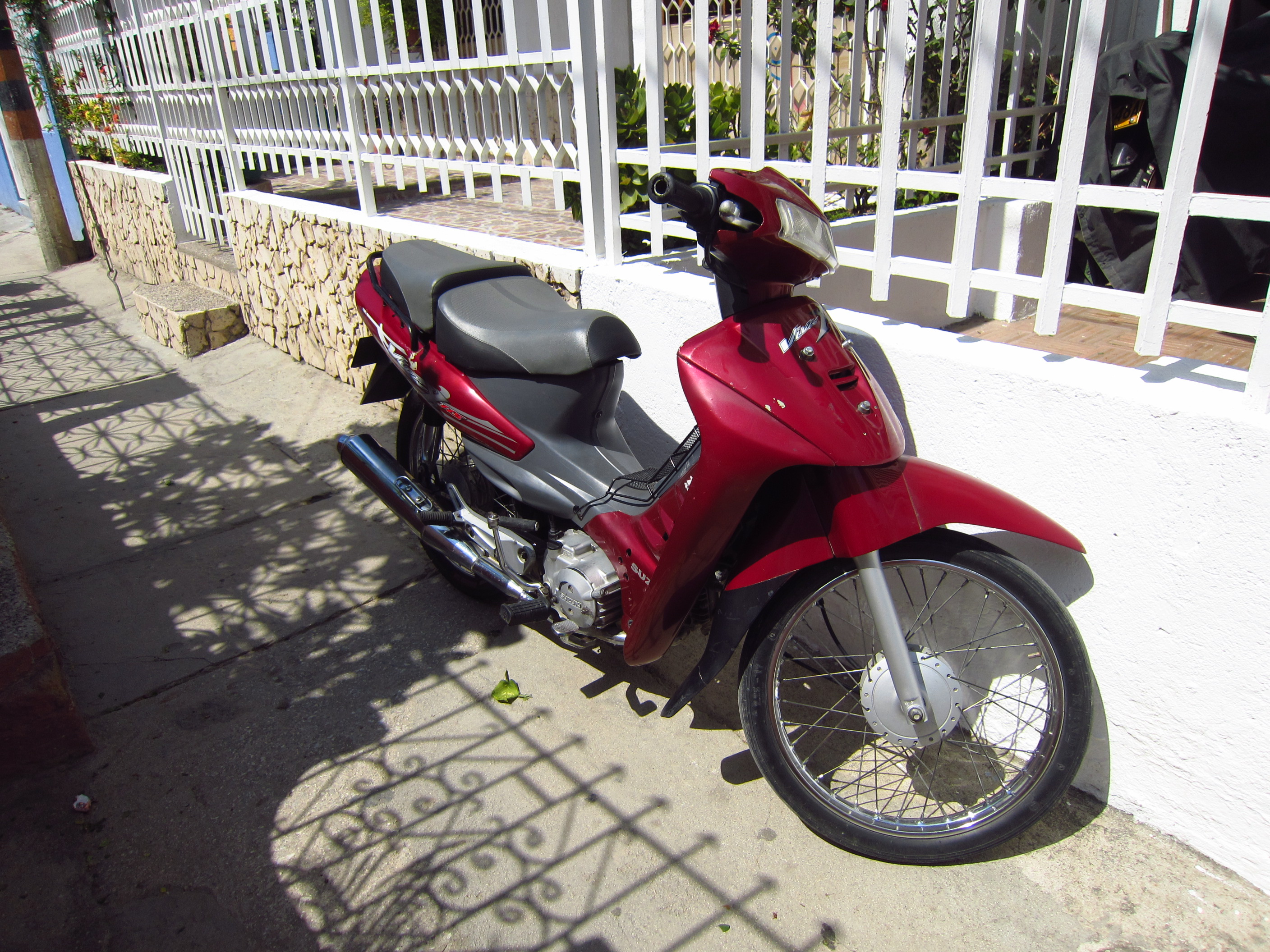
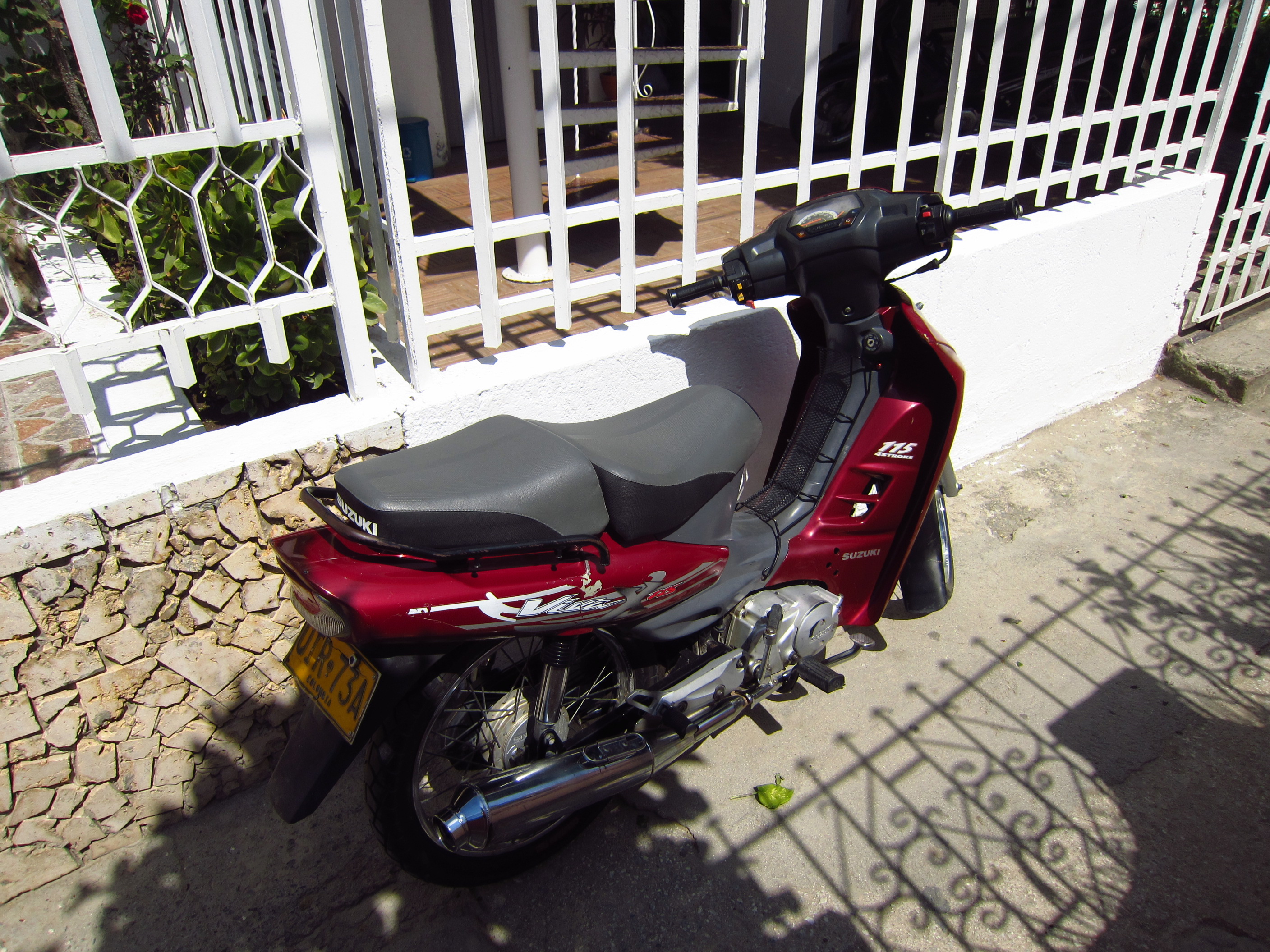
Today mi novio and I join the ranks of transport owners after buying a second-hand Suzuki motorbike, or as I’m accustomed to calling it, a scooter.
Coming from a country where the majority of people have a car to a place where the most common forms of transport are buses, taxis and mototaxis (motorbike taxis) has been an interesting change. Not everyone here has their own transport and it is still a dream for many people to have a motorbike and even more so, a car. I’ve come to realise how important transport, and lack of transport, is to lifestyle and culture. For many families even a local bus fare stretches the budget very tight.
I can’t count the number of times I took for granted popping to the supermarket or shops only to come home with a heavy load of groceries or a armfuls of shopping bags. That was when I had a car to haul my goods. Going to the supermarket here for a ‘big shop’ to stock up on bulky and big essentials such as washing powder, sugar and rice means having to pay a taxi fare to get home as it’s too far to walk carrying plastic shopping bags. The taxi fare is dirt cheap by Western standards, but constitutes a fifth of the daily minimum wage. No wonder the vast majority of families sh0p daily at their local corner store, buying only the quantities necessary for the day.
Our new motorbike, yet to be named…
Having a motorbike now means we have freedom. We can go to the beach without having to catch two buses. We can look for an apartment. We can visit family and friends (when I make some!) and we can go to the supermarket without having to take a taxi.
Mi novio has such a big smile on his face today. He’s so excited to have a motorbike and our own mode of transport. I’ll still use the bus regularly to get to the city centre because it is
convenient, but I’m looking forward to discovering more of Santa Marta from the back of the motorbike.
Today is Halloween, which is celebrated here in Colombia.
When mi novio and I went to buy lollies there were lots of little kids fully decked out in costumes looking cute, but my experience at giving out the lollies was far scarier than 3 year olds in bee costumes.
I was excited when the first kids came our front gate and so went out into the street to give them some lollies. Suddenly I was swamped by a group of about 20 kids, mostly obnoxious boys not wearing any costume or mask. They all put their hands out at me and shouted at me to give them lollies. I was overwhelmed, and told them there was enough for everyone but they had to wait their turn.
This seemed to rile them and they pushed and shoved and bullied and shouted and grabbed. I had my camera in one hand because I wanted to take a photo of the costumed kids but as the situation got more and more out of control, I called to mi novio and handed him the camera over the fence. As I did this, one kid started tickling my decidedly sweaty armpit to make me drop something and others tried to snatch the bag of lollies.
Feeling beaten, I retreated back behind the fence and started castigating the kids about being so disgustingly rude and disrespectful. It seems my Spanish is up to the task as they words flowed from me. Still they yelled and bullied with their hands between the rails and I had to give them lollies to go away.
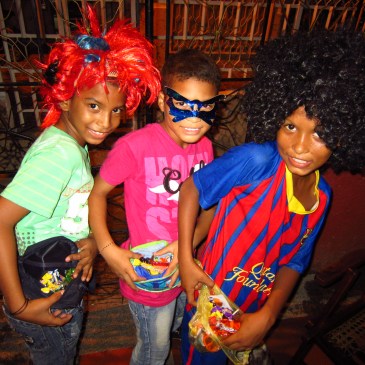
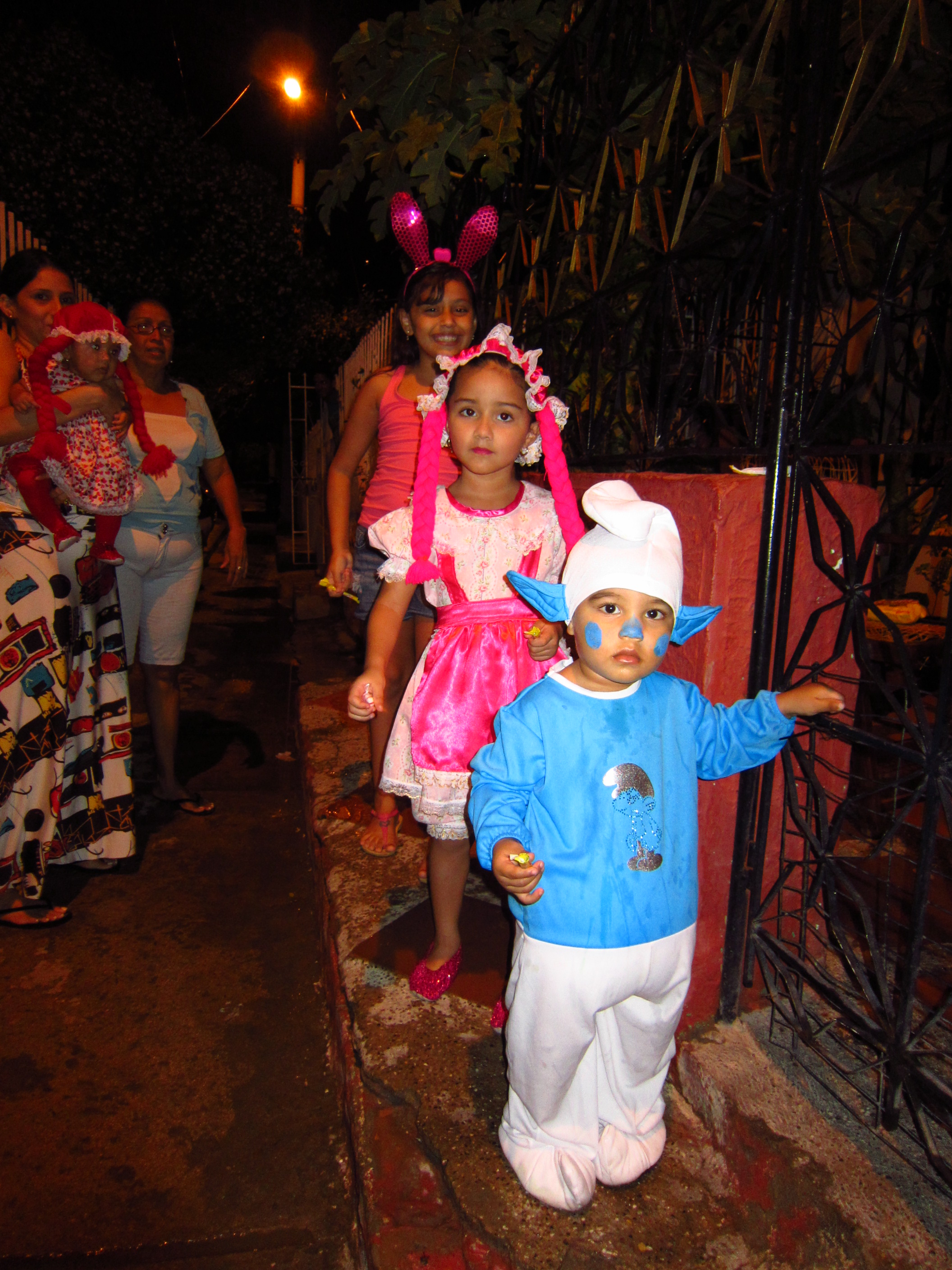
Cute little trick or treaters!
That was not how I imagined my Halloween experience. I had envisioned small groups of children who I could brainwash with environmental messages “Don’t throw the wrapper on the ground, put it in the bin”, but instead it got out of hand beyond all control and I was beaten by a group of kids.
Rubbing salt into my wounds, the kids then went to the house across the street (which is less than 2m from our gate) and they lined up like angels to get a lolly. It seems I have a lot to learn about kids and just have to thank my lucky stars that mi novio‘s son respects me and what I say.
Anyways, my evening was made a little better when the neighbour’s tiny kids came to trick or treat. They were so cute and now I want a little smurf!
When we surprised everyone with our arrival, the question of where mi novio and I would sleep came up.
The solution was we would sleep in his mother’s bed with his 8 year old son (who usually shares his grandmother’s bed) and his mum would share a bed with his brother since his girlfriend (who normally lives here) was visiting her family in another city. Musical beds! This was just a solution until the following day when we would go to buy a fan so we could share mi novio‘s single bed, as without a fan sleeping is pretty rough. (Although mi novio always used to sleep without a fan!)
The next day mi novio and I bought a fan and some paint to start work on transforming the storage/junk room into our bedroom. I wish I’d taken photos of how the room looked before we moved out all the car and motorbike parts belonging to mi novio‘s brother, Christmas decorations belonging to his mother and all other odds and ends you find in the junk room. I wasn’t quite sure that mi novio‘s teeny tiny room with space only for a single bed and small shelf would fit all the stuff from the storage room, but it did.
Mi novio set to work with the promise that the room would be read for us to sleep in that night.
We’d probably left our start a bit late in the day but with the help of his mother we cleaned the room thoroughly and mi novio fixed up the holes and dents in the walls and set to painting the roof and walls. Painting is not my forte, even less so painting ceilings and the roof here is made of a kind of ceramic corrugated plasterboard which is even trickier to paint. Lucky for me mi novio is quite the painter. Apparently he can also paint fancy, swirly feature walls that only people with money have in their houses because not many people know how to do it and it is quite expensive to commission. I have never seen these types of painted walls in Australia, nor can I imagine them being popular there, so I think it must be a latino thing.
Though we ended up sleeping in his mother’s bed again because I’d been struck with a bout of gastro and had to go to bed, mi novio finished painting the room that night, two walls white and two walls orange.
Mi novio suggested laying tiles on the concrete floor, but as I was keen to give la suegra (my mother-in-law) back her bed, I just wanted to move in and start unpacking the 7 bags we brought with us. So we moved in our luggage and the single bed for starters whilst we looked to buy a bed. Our new room had a closet space that was nothing more than a cement wall and roof but it needed a rail. So my increasingly handy novio installed a rail to hang our clothes. He also fixed up a hole in the floor, replaced the wood covering the door between our room and his brother’s room, filled in and painted the holes between the roof and the wall and added a plastic concertina opening door (to save space and give us privacy since all the bedrooms just have a curtain for a door).
A couple of days later we finally bought a bedroom setting which came with two bedside tables, a chest of drawers, a mirror and little seat that fits perfectly in our room.
Finishing off the fitout of our room are an Aboriginal artwork and an Argentinian tango print that we had framed, a couple of boomerangs, a bag rail and fab jewellery board mi novio made for me.
So now we have our privacy. We have a space to call our own and somewhere to keep our things. And mi novio did all of this with the minimum of tools, a drill, spatula, hammer (that has had the head cut to a stub), electric drill, screwdriver, roller and paintbrush, saw and a plasterer’s scraper. I’m very impressed and so thankful that we have our own space to inhabit until we find our own apartment, it makes the adjustment to Colombian living so much easier.
We’d kept it a surprise. No one in Colombia knew we were coming back earlier. They were all awaiting our arrival on the 21st of October.
The decision to come back sooner came from an intersection of a few thoughts and feelings. Mi novio missed his family. He’d been away from them for 4 months and he was keen to see them again. The travels we were doing in Argentina and Chile just exacerbated his desire to go get back on home soil. We also realised we were spending far more than we had budgeted. I had underestimated how expensive it was for two people to travel.
Unfortunately to change our flights was also super expensive. We virtually had to forfeit our flight and buy new ones. So we looked at travelling to Colombia by bus. Money can be a strong motivator and in a move away from my normal logic, mi novio convinced me that taking the bus was a sensible financial option and that it wouldn’t be the nightmare of my imagination.
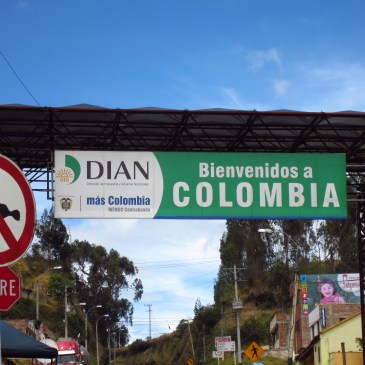
After 11 days en route from Argentina, 4 border crossings and 7 nights sleeping in buses, we arrived to the tropical heat of Santa Marta.
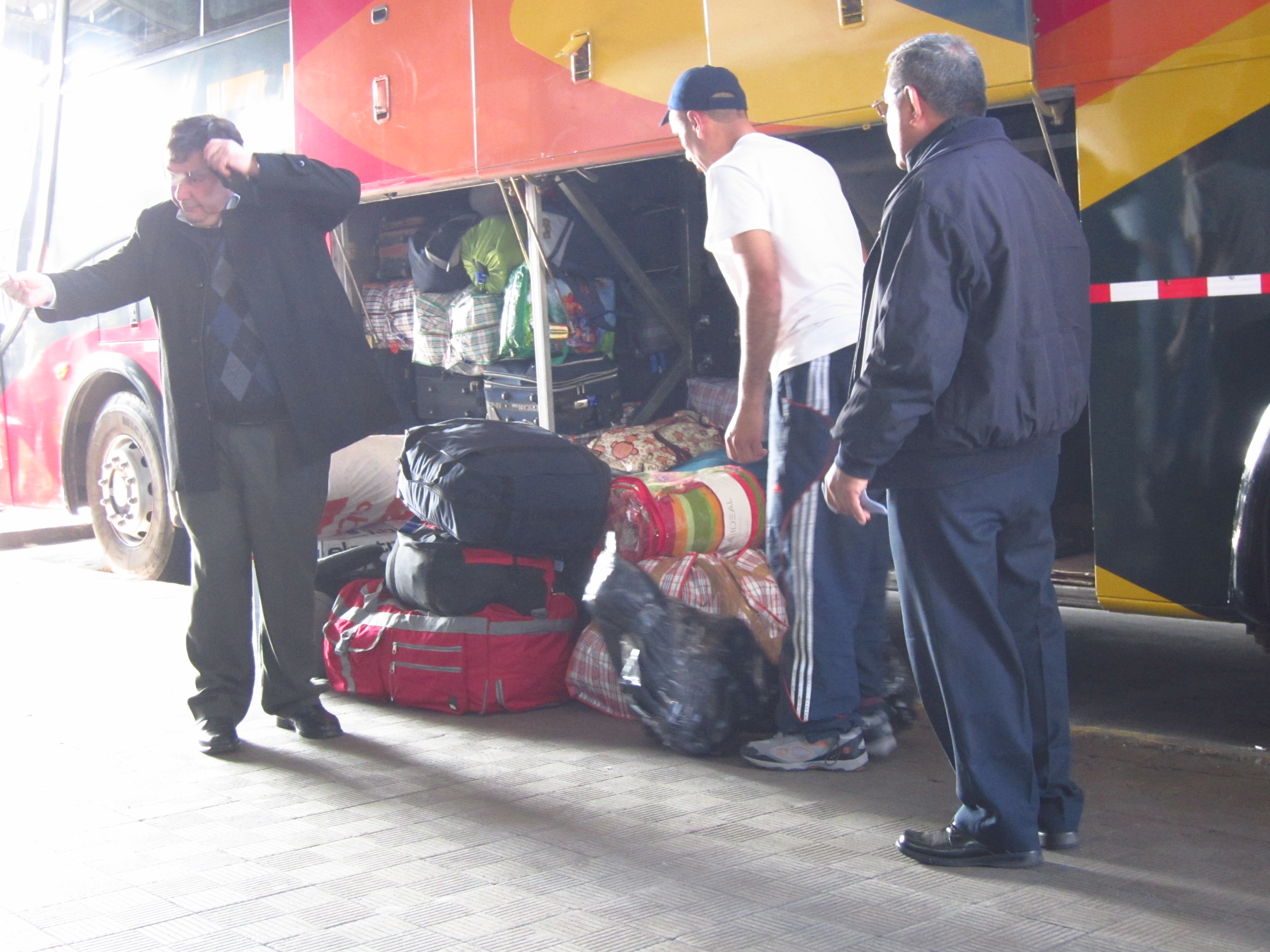
Loading bags in Santiago. Even an excess baggage charge doesn’t compel people to travel lightly.
Laden with 2 suitcases, 2 large backpacks, 2 small backpacks and a carry-on bag we walked the narrow street to mi novio‘s house and opened the gate. From inside the house there the was a flurry of excitement and shouts as the realisation of our early arrival dawned.
Almost two weeks after arriving and with the flights we have booked set to fly tomorrow, I can look back and say it was a good decision to come back earlier than planned. What we’ve accomplished in this time here and the money we’ve saved are just two small benefits when compared alongside the reunion of family and the happiness I saw on his son and mother’s faces.
Although the 11 days of travel and 7 nights in buses faded into a distant memory as soon as we left the bus terminal in Santa Marta, it is an experience I am not keen to repeat and I still think we are slightly crazy for giving up the airfares that would have got us here in 8 hours.
Are you also looking to do an international bus trip in South America?
Here’s some details of our trip to help you out.
Buenos Aires, Argentina to Santiago, Chile > approx 19 hours. Most companies offering this route stop in Mendoza. Cata Internacional has a daily direct bus. We took Pullman Bus which leaves Sundays and Wednesdays and was $450 Argentinian Pesos each (other companies quoted $500 pesos). This was probably the most attentive service we received on the buses. We were plied with coffee and soft drink, given a snack sack, dinner was provided in a restaurant and a ham and cheese sandwich provided for breakfast and there were good, new release movies shown. The seats weren’t as comfortable as some of the others but we were provided with a pillow and blanket. Our tickets said we could take 20kg of luggage each, but this was not weighed. Note: We went to Santiago to pick up luggage we’d stored and there are direct buses to Lima from Buenos Aires.
Crossing the Chile/Peru border.
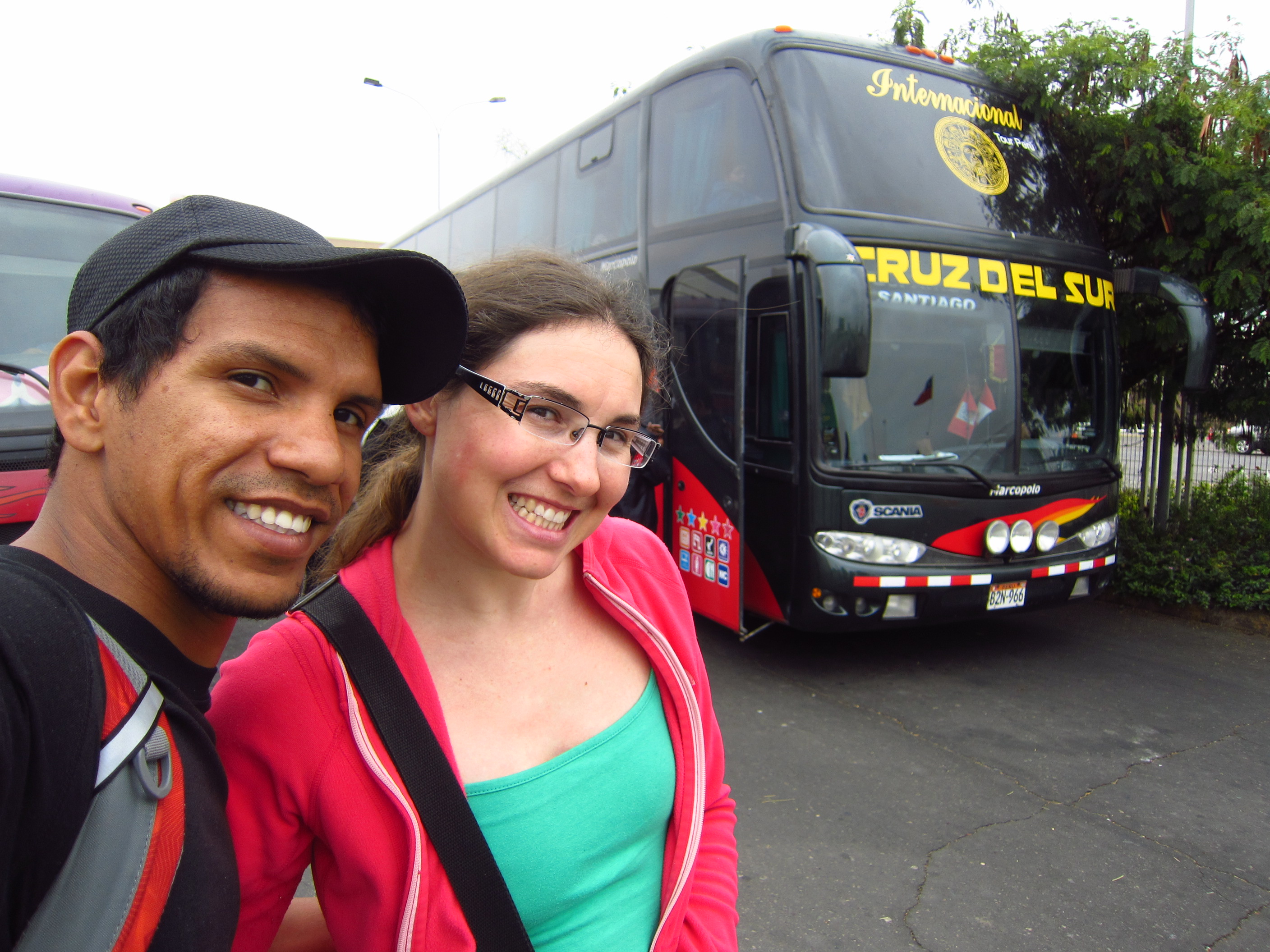
Santiago, Chile to Lima, Peru > approx 52 hours. There are a few companies (Cruz del Sur, Ormeno, Andesmar and more) that offer this service, although they all operate on different days. We went with Cruz del Sur and paid $40,000 Chilean Pesos each. We chose Cruz del Sur for the departure day and also because they provided service on board the bus and most meals and also for the baggage allowance of 30kg. The bus companies seemed to be stricter on overweight baggage than airlines, and we had to pay 800 Chilean pesos for each kilo overweight. I would definitely recommend Cruz del Sur as we received very good service from the dedicated waiter who always advised us 10 minutes before we were to stop and told us how long we were stopping for. He also kept the movies going back to back during the trip and showed a good variety of new-release films (ie not just action films!) and he was also helpful at putting on the English sub-titles when I asked. Blankets were provided. Cruz del Sur have a connecting service to Guayaquil, Ecuador if you are heading further north.
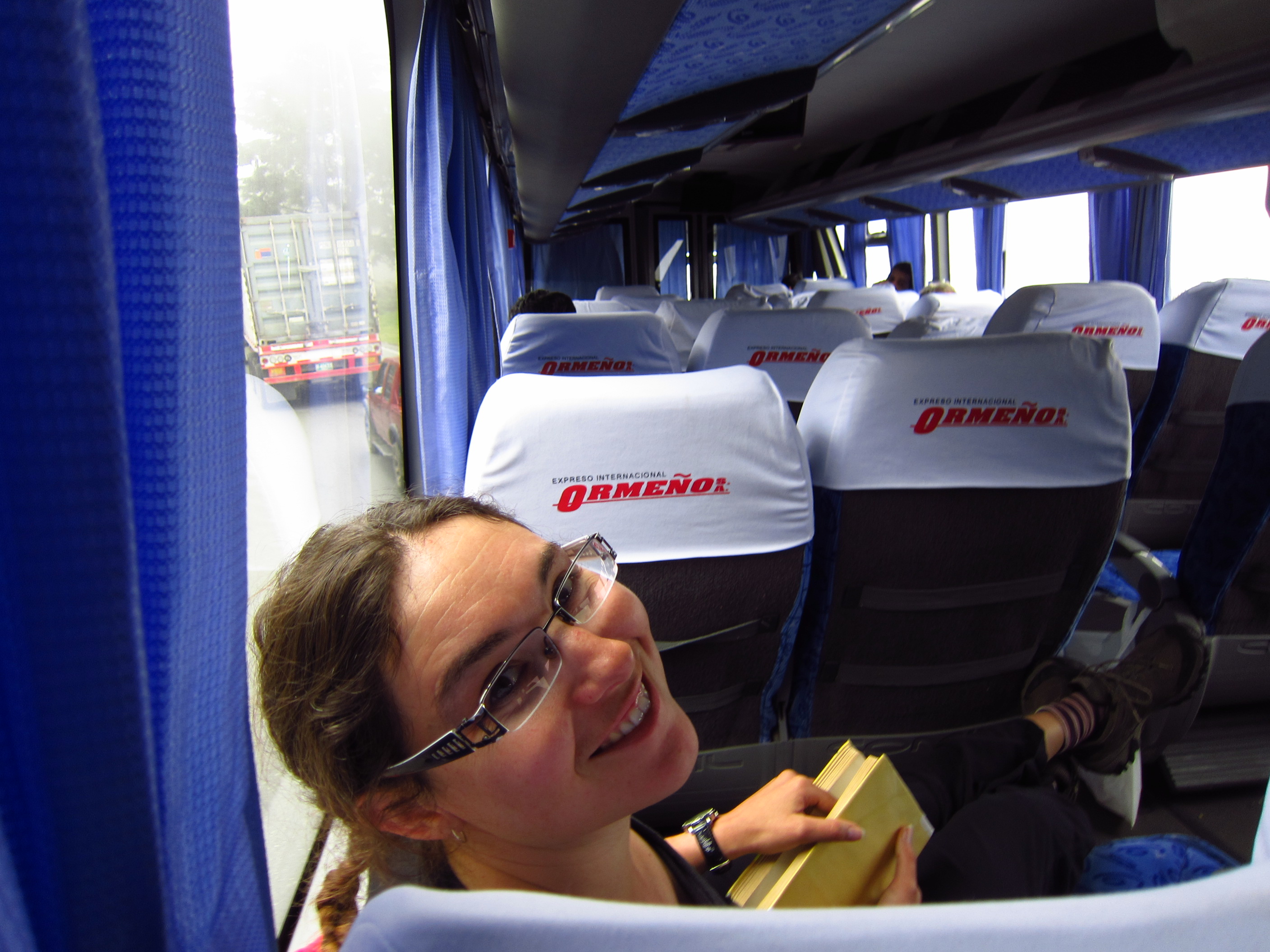
Enjoying the space on the bus after most passengers got off in Cali.
Lima, Peru to Bogota, Colombia > approx 76 hours. There weren’t as many operators as we had expected, and since Lima doesn’t have a central bus terminal, it’s even harder to find them. In the end we had to go with Ormeno despite having read bad reviews online and hearing that it is just a bus trip, there is no service included. We paid US$180 each (you can withdraw US dollars from ATMs in Lima and there is an ATM inside the terminal. This did not include any meals. The bus stops at various places for you get off, go to the toilet for number 2’s and eat. Two drivers completed the entire distance and they were drivers only. They didn’t advise anything about how long each stop was for and were rather surly when asked anything. The seats were the most comfortable of all the trip with a pillow top cushion. However there are no blankets or pillows provided for a journey of 3 nights (this bus also stops in Guayquil and Quito, Ecuador and Cali in Colombia and some days has an onwards service to Venezuela). We were also only allowed 20kg of stowed luggage and 6kg hand luggage. Each extra kilo was charged at US$1, however they were slightly less precise about the weighing process and didn’t charge us for the full overweight baggage we had. Ormeno definitely wasn’t as good as other companies and the movies were sporadic and seemingly of the one genre, but also it wasn’t completely horrible.
I have just finished reading my first book in Spanish.
The copy I gave mi novio
Yay me!
It took me awhile, but I finally got to the end.
It started in Bogota in September last year. I was wandering the streets one Saturday morning and in a little plaza off Calle Septima, I found a tiny used book store. Unlike most bookstores we’re used to, there weren’t any aisles to browse, just shelves of books behind a glass counter.
I asked if they had The Alchemist by Paulo Coelho, indisputably my favourite book, one I have read at least 7 times in English and gifted to others many more times. I figured that since I already knew the story so well, I would understand it even if I didn’t know all the words.
They showed me a few copies and I selected a lovely embossed paperback that felt slightly furry. It was beautiful. In between a couple of pages I discovered a homemade bookmark of tiny pressed flowers arranged and laminated. That was a lovely surprise.
I started reading and it was slow going because I noted every unfamiliar word in my book and at the end of each section, I consulted the dictionary, translated and reread the passage again.
My progress stalled when I went looking for a copy for mi novio in Santa Marta. It seemed that in a city of half a million people there was only one bookstore, and they didn’t have a copy of The Alchemist. I tried a stationery store that had a few books as well, and the large supermarket chain Exito, and even held out hope to find a copy from a street vendor but I couldn’t find it anywhere in Santa Marta. Out of options, I decided to give mi novio the beloved copy I’d bought in Bogota.
My copy of The Alchemist
I found my current copy of The Alchemist, a 20th anniversary commemorative hardback in the spiritual section of a fancy bookshop in Cartagena’s old city and I brought it back home with me to keep practising my Spanish.
During certain times, I get the urge to reread The Alchemist. Usually it’s a feeling of being out of control or when I’m feeling like the road ahead is long, boring and hard. Paulo Coelho’s words help me to see that everything is connected and it is all part of the journey.
Being away from mi novio for such a long time is so hard and one day I decided I needed to read The Alchemist to feel better. Since I’d already started it in Spanish, I said to myself “Righto, I should finish reading it in Spanish.” But I didn’t want to trudge my way through it with a dictionary in hand so I made the decision to just jump right in, forget about the words I didn’t know and just keep reading.
This is probably one of the best things I could have done. I came across about 3 or 4 words per page that I didn’t understand. Some I figured out just by reading, and others I guessed. Only a handful still baffled me, but the most important thing was I was reading and following the story! When learning another language one of the eureka moments is when you are able to read a book in that language. Starting with books you’ve already read in your native language makes it easier to follow the story in another.
I’m already looking forward to having another one of those “I need to read The Alchemist” moments, but the next one will most likely be
“Bueno, necesito leer El Alquimista.”
Do you speak more than one language? What was the first book you read in another language?
As soon as I left the hostel this morning, I got my first comment.
A dirty man sifting through rubbish followed me with a barrage of comments on my looks and appearance. That set the tone for the rest of the day as I constantly had people staring at me and dishing out comments. That is the thing I hate the most about Latin America.
By the time I got to the Metro station, I realised the errors of my ways. I was the only female with bare legs. While I was wearing denim shorts, the rest of the girls were wearing jeans two sizes too small. This latina condition is what my roommate at the hostel calls “chicken bus jeans” – they pack as much into there as possible and as long as they can close the door most of the way, all is good.
So for the rest of the day, I copped a stack of (unwanted) male attention. This is one of the reasons I´ve decided to head back to Bogota. At least it´s too cold to wear denim shorts there, and I seemed to be able to roam the streets without the looks and stares.
Words cannot begin to express how excited I am to be going to Colombia.
Firstly there is the yearning for travelling in Colombia that I’ve had since April 2004 when I was in the tiny jungle border town, Leticia. I made a vow to come back and now it is finally happening. Initially I told myself I wasn’t removing the red, blue and yellow wristband I bought there until I returned, but after going home and getting a professional job, that had to come off. But has been with me all the time hanging from my keychain. So as you can imagine, I’m really excited to see that dream come to life.
Secondly, I have had my fill of the US. After 6 months here I am desperate for some new scenery and culture. I think the longer I stay here, the less I like being here. Despite all the wonderful people I’ve met, and the places I’ve enjoyed as I crossed the country, I just don’t like being in America. It’s a strange feeling that’s hard to describe. There’s something that makes me feel uneasy, and then there’s so many things to appreciate about Australia that you only pick up when you speak to people about how it is here, like annual leave, maternity leave and health care.
Whilst I feel like this now, I also know that I will be back and travelling in the this country in the future because I want to revisit the friends I’ve made and also see the things that I missed on my planned return leg like Niagara Falls, Chicago, Mt Rushmore, Yellowstone, Glacier National Park, Olympic National Park, Seattle, Crater Lake National Park, Portland and Yosemite. It’s just that next time will be for a much shorter period of time, and hopefully with a friend.



 a little cameo