First random act of kindness in Bogota

It’s  been a big and exhausting week filled with adjusting to Bogotá’s altitude, wrapping up in warm clothes, being in the big city, finding my way on local buses, starting my new job and apartment hunting.

We spent a full day on Monday going to various inspections we had lined up and also traipsing around the general area we are looking to live in looking for Se Arriendo signs that indicate a vacant apartment. Renting an apartment in Bogotá is not easy because of all the requirements you need to meet, and I’m sure I’ll write a post about the house-hunting process sometime soon. We had a couple more inspections on Tuesday and Wednesday and currently have our application in for a fabulous apartment very close to my work. We have our fingers crossed everything goes through fine and that we can move in next week!

On Tuesday I started my new job and I already love it. It’s going to be interesting, challenging and I get to work with a great bunch of professionals in a bilingual office environment. I also have an office window that looks out over Bogotá with a most incredible view, so you can be sure I’ll be taking regular ‘rest your eyes and look into the distance away from the computer screen’ exercises.

Last night on the bus back to the hostel where I’m staying until we get an apartment I was on the receiving end of lovely piece of Bogotano kindness. Buses are notoriously jam-packed and if you end up standing in the aisle, you have to hold on with two hands firmly gripping the rails in a white knuckle embrace so as not to be flung around like a bowling ball as the driver brakes and swerves at high speeds. The girl standing next to me, who wasn’t tall enough to reach the ceiling rails, slipped into the newly vacated seat directly in front of her (but not before hovering over the seat for just a minute in a Bogotá idiosyncrasy I had read about on Banana Skin Flip Flops and Sarepa). I moved a step down the bus to where she had been standing and she obviously saw that my oversized shoulder bag was heavy, awkward and in serious danger of smacking her in the head, so she said “Te ayudo?” (can I help you?) motioning to take my bag for me. So I handed over my bag which she nursed on her knee until I got off. I had seen the exact same kindness the day before by a girl sitting next to me taking the unwieldy backpack of a guy standing in the aisle and resting it on her knee and the day before that when a man gave up his seat for a pregnant woman and she returned the favour by minding his bag for him.

This small gesture is surprising because it is where famous Colombian hospitality and Bogotano politeness meets an ingrained mistrust of others and wins. Mi novio keeps telling me to be careful on the buses because they have a reputation for thefts, and here I am handing over my bag with all my important papers and valuables to a perfect stranger to mind for me. I have seen and heard of many examples of Colombian’s mistrust in others, right up to not trusting family members, although I think that is mostly about not trusting anyone with your money. But I love that regardless, people are lovely and helpful and kind. It makes me love this city a little bit more.

This week has passed by in such a blur that I’ve had to pinch myself that yes, I am in Bogotá and yes, life is great.

Terms of Endearment

I remember my Argentinian teacher of Spanish back in Melbourne telling me that Colombians are muy cariñoso. Meaning they are warm and cutesy, especially when it comes to describing things.

Colombians will often go overboard on the cutesy-fying by adding -cita/o or -ica/o or ita/o to the end of any word. A cute cat is not a gato, it is a gatico. To describe something soft they will say suavecita not suave. You don’t just have a juice because your jugo becomes jugito. Adding these suffixes becomes a gentle way of describing things and actions. It’s quite adorable and I have been guilty of using multiple cutesy suffixes in one sentence for example in reference to seeing a new lamb with the flock of sheep that walked past my office window daily I exclaimed “Ooooh! Es un bebecito corderito rather than simply saying “Ooooh! Es un cordero.”

Another type of diminutive is mami and papi. The Spanish equivalent of mum and dad is mama y papa and so when we say mummy and daddy they say mami y papi. Easy enough to figure out, right? That is except for the fact that mami and papi are also general adorable descriptions for anyone. Parents will call their daughter mami and their son papi. Grandparents will call their grandchildren mami or papi. People will call their partners mami or papi. And complete strangers like bus drivers and shop owners will call you mami or papi. It’s quite confusing and there is no parental relationship required for the moniker.

For example, on the bus the other day I climbed into the front seat (always my favourite place to sit in Santa Marta’s dilapidated mini vans that swerve down the streets with the side sliding door jammed permanently open) the driver said to me “Shut the door well mami“. Had I been fresher off the plane, I think I would have been slightly offended by this, but now the indiscriminate use of mami and papi is nothing to bat an eyelid at.

It should also be noted that mami is far more respectful than mamacita, something that is more of a phoar or catcall in the street and something I haughtily turn my nose up at.

Whilst it’s not solely Colombians who use diminutives, they certainly take it to a whole other level in comparison to other latinos.

So rather than signing off with chau, or bye, I will say chauito.

What are your favourite Spanish diminutives?

PS Partway through drafting this post, la suegra used tareaitas (little homework) when speaking to D about having to do his homework. I’d never heard that one before!

The Photo Vault: The Birthday Tradition


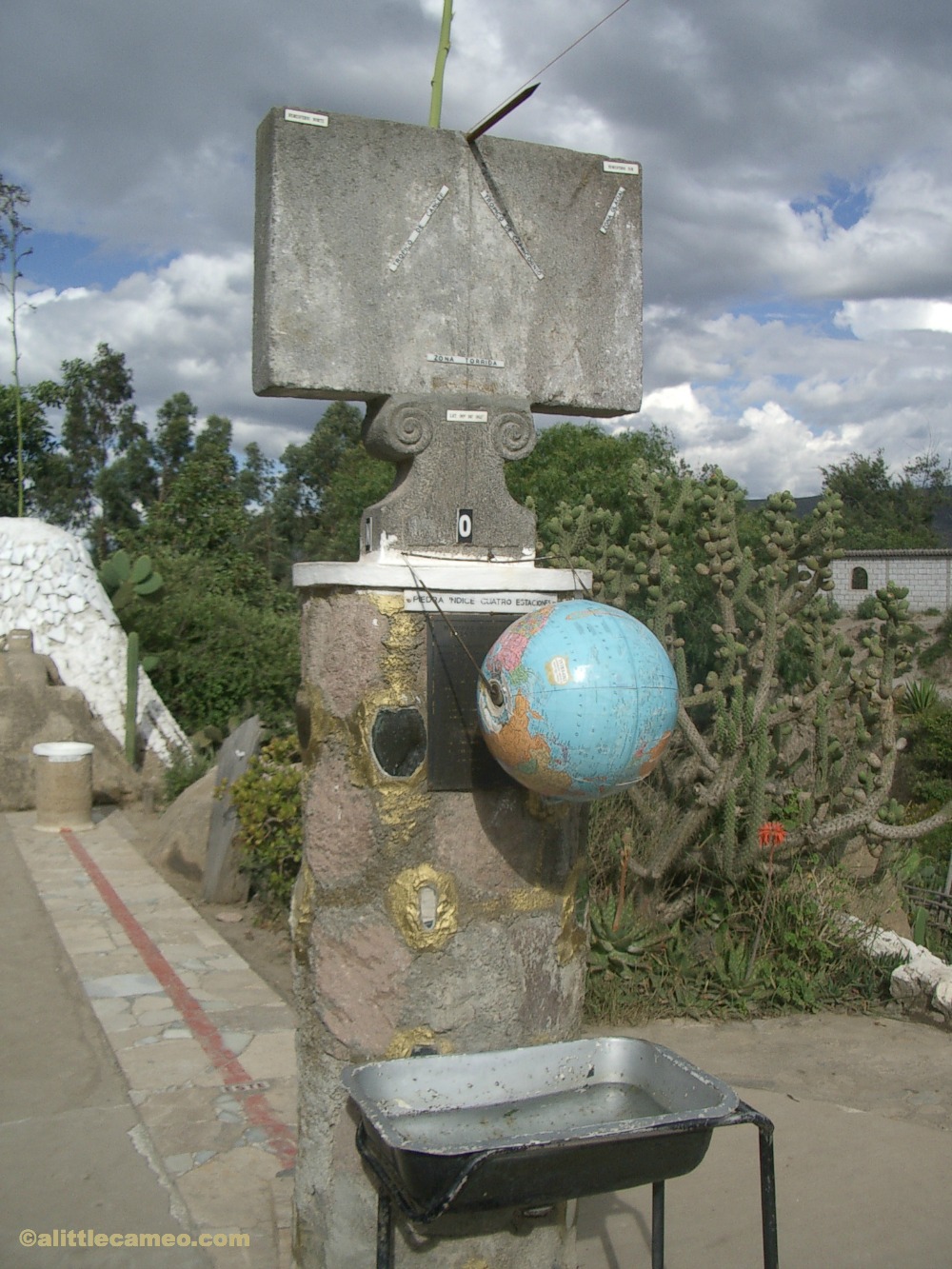
The interactive and informative museum on the equator

Quito, Ecuador, May 2004

As my 25th birthday approached, I started coming up with ideas of where I would be to spend my quarter of a century. As I was travelling, the options were pretty much endless. I´m not sure where the idea came from, but I decided that visiting the equator and jumping backwards and forwards from Southern Hemisphere to Northern Hemisphere and doing a tip-toe balancing act on the equator would be an awesome way to celebrate my day.

I was travelling on my own and hadn´t met anyone else at that stage who wanted to tag along to the various equator attractions in Ecuador, so I went on my own. I visited the small, interactive site which is on the actual equator and did all the cool things like balance an egg on a nail head and watch water swirl down the plugholes clockwise, anti-clockwise, and straight down (over the equator). I tried my hand at shooting a blowdart into a cactus leaf and generally had a great time.

I then went to the official equatorial monument, a large and bland site, that is just slightly off calculation and therefore not on the actual equator.

Back at the hostel I went out to dinner with some others and when they found out it was my birthday they ordered me a cake and a sparkler. It was a great day.

Ever since this birthday, I´ve always done something interesting, different, or just gotten away from it all so that I could spend my birthday doing something that would make me happy because in my early twenties, I realised that my birthday is only special to me, so rather than rely on others to make it a great day for me, I had to take it into my own hands. Since then I´ve hiked in national parks, gone parasailing and kitesurfing, rafted through the Grand Canyon, visited Angkor Wat, biked around Rottnest Island, climbed the Sydney Harbour Bridge and hit the beach in Mexico.

This year, I´m back in South America for my birthday, just over the mountains a bit from Ecuador where the birthday tradition started. So today, for my first birthday in Colombia I went tubing in the rapids of the river in Minca, not far from Santa Marta. I never really expected to start such a tradition as I stood on the equator, but I love it and I´m keen to see what exciting things I do and interesting places I go for the birthdays to come.

* If you are interested in more information about the museum at the equator, The Souls of My Shoes blogged about her recent visit and more fun activities that can be found at the equator.

The Photo Vault is where I will be sharing my favourite photos (and their stories) that deserve better than being lost in the depths of my iPhoto never to be shared.

15 reasons I´m excited about moving to Bogotá

In my second big announcement of 2013, comes the news that we are moving to Bogotá!

I´ve had an iron in the fire for a position since mid January and will finally be starting very soon.

Am I excited? You bet! And let me tell you why (in no particular order).

  1. I fell in love with Colombia in Bogotá
  2. I have an amazing new job that I have dreamt about for a long time
  3. We will finally be living on our own in our own apartment
  4. Bogotá has so many cultural activities to participate in and enjoy
  5. Bogotá is a crazy, creative city
  6. I get to wear nice clothes (and leave the shorts and singlets in Santa Marta)
  7. No more sweating 24 hours a day (unless I am sick)
  8. I get to wear boots again!
  9. No more earning minimum wage
  10. Getting to choose (and prepare) the food I want to eat
  11. Spending time and reconnecting with my friends there and making new friends
  12. Drinking water out the tap, no more boiling for 5 minutes or getting up in the middle of the night to find someone has drunk the last of the purified water
  13. Having professional work colleagues
  14. Having more travel destinations (Colombia and beyond) accessible to us for weekends or short breaks
  15. Crepes and Waffles!

Are there any other reasons you think I should be excited to move to Bogotá?

Cue TV addiction

My mind is still spinning. I can´t believe that I didn´t find this out 6 months ago when I first arrived in Colombia.

Whilst I´m not much of a TV watcher – perhaps a product of not converting to digital TV when they turned off the analogue signal in my hometown a few years ago because I had already stopped watching due to sucky reception and didn´t think it was a priority to upgrade my antenna – television in your native language  is oh so very comforting when you live in another.

I don´t mind watching programs or movies filmed in Spanish and I do have a favourite telenovela (the Colombian soapie Amo de Casa), but I abhor anything dubbed from English into Spanish. Urrrgh! I refuse to watch dubbed movies at the cinema, only going to the sessions in English with Spanish subtitles. I cannot stand the horrible voices that don´t match the characters, the actors or the mouth movements.

So whilst it´s much easier to find English language programs in Colombia than it is to find Spanish language programs in Australia, it´s mostly dominated by the Kardashians, celebrity rehab programs or other trashy reality TV shows. When I´m desperate, they suit just fine for a fix.

The other day when refusing to watch a movie with its non-original language, I had to explain to D what doblada (dubbed) means. He was confused because in Spanish, doblada also means folded. While I was at it, I also had to explain subtitulada, which hopefully you´ve already guessed means subtitled. I told him that it is very hard for me to watch something in Spanish when it was originally filmed in English and proceeded to explain that the TV show he watches Mi niñera es una vampira (My Babysitter´s a Vampire) was filmed in English and that someone else says the words in Spanish. D then said to me something which has changed my world.

You can change the language on the TV to watch it in English.

Whaaaaaat?!?!!?!?

He proceeded to casually demonstrate with an expert flick of the remote control how he could select to watch a show in Spanish or English. Oh. My. Gosh. Upon seeing my astounded but gleeful face he asked if they were speaking English, to which I practically sobbed, yes! I didn´t realise the TV cable box was so smart. Far smarter than me if it´s taken over six months to discover this functionality that the nine year old has known about forever.

He told me (and showed by way of more flicks of the remote control) that it doesn´t work on every program, which is a given if it wasn´t actually filmed in English, but I love that the original version is available as an option. I think my sanity is one step closer to being kept!

Suddenly a whole new range of entertainment options has been opened up to me. I can watch a movie in English instead of Spanish. I can watch TV shows and documentaries in English. I can vegetate in front the TV instead of in front of my computer. Only one thing stands in my way, the non-English speakers in my household who have preferences for watching telenovelas and cartoons in Spanish.

Do you prefer watching foreign language programs dubbed into your native language, or with the original sound and subtitles?

The Photo Vault: Millewa Pioneer Village


Millewa Pioneer Village

Millewa Pioneer Village, Victoria, Australia, 2006

A journalist friend of mine had a story to file about an open day at the Millewa Pioneer Park in Meringur, a tiny town about an hour or so from Mildura, so she invited me along for the day. I was very involved in my community, and this is just one of the types of things that would fill up my weekends.

The Millewa Pioneer Village is a site where a collection of buildings and vintage farm implements, show what life as a farming pioneer in the olden days was like. There is a good collection of history and displays that while interesting, also show the decline in population that is is an important issue in rural Australia.

The population drain on rural and regional Australia isn´t just the young people being drawn to the bright lights of the cities for study and work, but is also a result of changing farm practices, technological advances in agriculture and economics. In order to make a living, farms are bigger than they were when the settlers arrived to farm their parcel of land. Over the years farms have been consolidated, and what was once a viable farm for a family and their grown children also working the farm, no longer provides a living for just one family. So as a result of the growing farm sizes to support a family, the population in these rural areas has declined to reflect this change.

It´s a difficult issue because services that were once available, also become unviable. But one of the beautiful things about rural communities is their spirit and their tenacity. The open day was a success and many people came out to support the day, not just locals, but people from Mildura and other small towns.

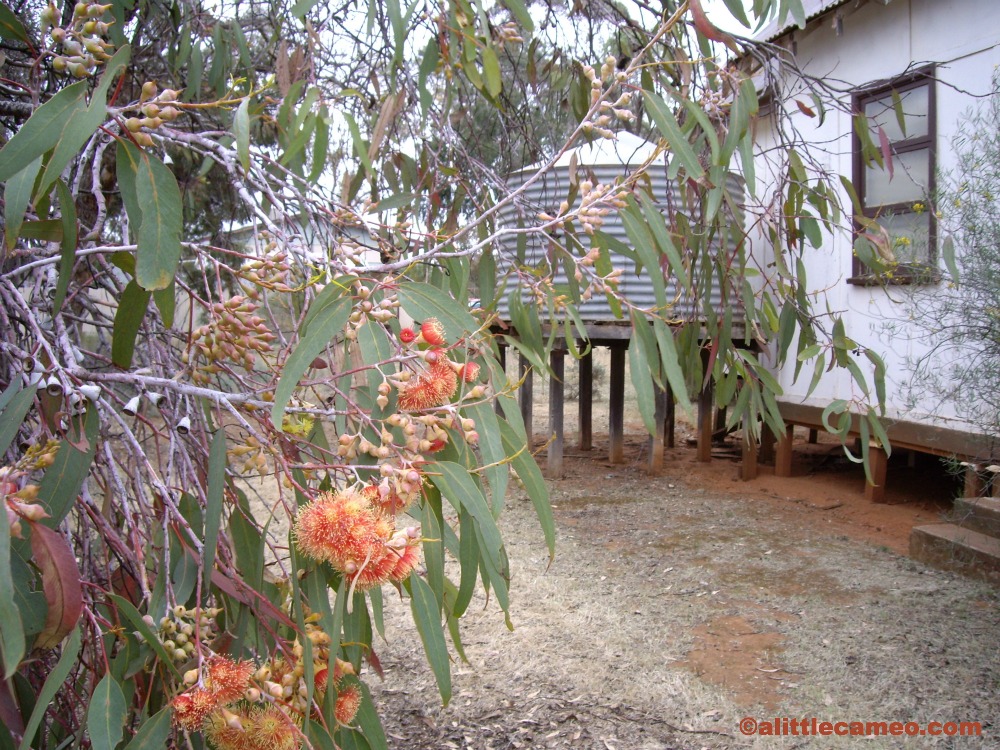
I miss my community. I miss being involved in activities and events that make my hometown a better place. I miss the friendships and acquaintances I have there and I miss bumping into people I know and having a little chat truly caring about what they are up to. I haven´t yet found a way of carving out my own community here in Santa Marta, and perhaps that is another factor making me feel rootless at the moment. But this photo, of the mallee scrub, with a gorgeous flowering gum and the iconic corrugated iron water tank makes me feel that my community will always be there, waiting for me to return.

The Photo Vault is where I will be sharing my favourite photos (and their stories) that deserve better than being lost in the depths of my iPhoto never to be shared.

The case of a little crash

On my way to work on the back of our motorbike today we were involved in a little scuffle with a taxi. No one was hurt, nothing was damaged, but this is what happens when you do have a little bingle.

After putting some air in the back tyre, we headed off along Carrera 19 towards Taganga, like we normally do. There is a bridge over a small river where I´ve seen people digging the silt out of the river to cart off to make bricks. This is illegal, but just the same as dumping used and broken concrete in whatever vacant lot is, it happens and most people turn a blind eye to it.

This bridge is just before a busy intersection, and what usually happens is the bridge becomes a traffic bottleneck. We hadn´t yet come to the bridge but had happened upon the traffic knotted in zero semblance of lanes. We were in the far left “lane”, next to a thin concrete median strip delineating the two directions and just before a gap in the median. We had come to a stop due to the traffic and the taxi beside us that had started to veer in our direction.

I thought the taxi would see us and stop veering, but no. While we were stopped, he turned over the top of us to do a U-turn. All of a sudden the taxi was brushing my leg and I put my hand out in front and banged on the back window because it was about to drive over the top of us.

The taxi driver stopped in the middle of the road and the turn, hopped out of his car and proceeded to start shouting at us. He said he had right of way, that he had his indicator on, that we weren´t allowed to pass on the left (last time I checked on this side of the world this is considered the fast and overtaking lane).

So mi novio started yelling back. “You didn´t even look before turning, you can´t do a U-turn here.”

Within seconds of the shouting we were surrounded by onlookers. People driving past suddenly pulled up their motorbikes and stopped to watch the argument. Colombia is a nation of sticky-beaks.

Another taxi drove by slowly and called out the window that the taxi had right of way. Other motorbike riders were throwing their two cents in saying the taxi was in the wrong. The taxi versus motorbike war had found a new site to battle on.

An unmistakable wine coloured stripe was smeared along the side of the taxi and further above that a longer black stripe that the taxi driver was claiming as our fault. Clearly the wine coloured stripe was from our bike from where the taxi had ridden over the top of us, but as mi novio tried to lean the bike away from the car, the higher black stripe was most likely not from our handlebars or bike. Needless to say, these stripes are easily removed with a slight amount of buffing and there were no permanent scratches to either our bike or the taxi.

The taxi driver wasn´t convinced, wasn´t happy and was in the mood to argue despite having passengers waiting to be delivered to their destination in the back of the taxi. He said he would call the police, although in these circumstances there is nothing the police can do; no one is hurt, nothing is damaged. The police just stand around and wait for the two parties to reach an agreement and direct traffic around the scene until such time.

As the taxi driver took down our number plate, I told mi novio to take a picture of the accident from our perspective on the bike. A photo to prove that the extent of the damage was only a washable transfer of paint and so that should the owner of the taxi come looking for us and ask us to pay for damages, we have grounds to refuse.

I´m extremely relieved that the little crash wasn´t any more serious. There are so many accidents in Santa Marta every day, and with the huge numbers of motorbikes on the streets, it isn´t surprising. Every day it is a struggle between cars, motorbikes and non-existent lane markings. Whilst we are in the motorbike camp and a motorbike is a much quicker mode of transport given that no traffic lights operate on a system giving the city good traffic flow, I do love every 10th and 25th of the month, when in Santa Marta it is dia sin moto. These are the two days each month where you can´t use your motorbike, and I relish the calm and peace in the streets.

I´m not a believer in the crack down and restrictions on motorbikes that are starting to come into effect for people, because I understand the importance of transportation in a person´s daily life and quite honestly, only a small percentage of people in Santa Marta can actually afford a car. We certainly can´t afford a car. But I do think that more efforts should be focused on making sure motorbikes have all the paperwork, including a license for the drivers, a roadworthy certificate and insurance. If all motorbikes met these requirements, I believe that the streets would be much safer, and maybe there would also be a greater respect for other road users and pedestrians.

Colombia, you give me fever

I’m not a very good sick person. You see I’m not really used to being sick. I usually get a cold each year, but it’s never anything too serious, and in my working life I have rarely taken more than a day or two of sick leave per year.

I’ve been in Colombia for six and a half months now and I’m sick for the third time. And not just with a runny nose or a headache. I’m talking fever, nausea, sweats, body aches, incredible weakness and a hacking cough like I might just be about to spit up a lung or a windpipe. I’ve been told that it’s a virus going around, but I’m not sure why it needs to pick on me for the third time since arriving here.

I have spent the last two days in bed in our sauna of a room being a demanding patient. I whimper at night because I’m over-tired but can’t sleep and feel distressed. I send mi novio out to buy me sueros, which are electrolyte drinks to combat dehydration, lemonade and make endless trips to the fridge at all hours of the day and night to bring me water which I gulp down greedily. I look and feel miserable and demand massages for my aching body and hugs for comfort. As a normal person looking at my behaviour I’m horrified, but I wonder if my amazing novio was less attentive and patient, would I still be acting like a big baby?

Thinking back to my childhood experiences of being sick, mostly with asthma that kept me on the couch instead of at school, and at one time had me in hospital at age seven, I was probably the same. Whenever I was sick and had difficulty breathing I would start to get distressed and sooky and cry to Mum to give me hugs. She would tell me not to get so worked up and would rub my back soothingly. In short, she would give me attention.

Now I’m here on the other side of the world, I can’t get one of Mum’s all-curing hugs and back rubs, but I have a doting novio who is prepared to do whatever he can to help me feel better. He even tells me that I look beautiful while feverish and sweaty with hair sticking to my face. Is that what they call pure love?

I’m on the mend now, thank goodness, which is why I can sit up to type this instead of slumping in the bed like an invertebrate with my eyes closing from weariness every five minutes. I just want to know why Colombia is making me so sick, and if I’ll always be an attention seeking sook when I get sick.

What’s the most demanding thing you’ve asked for when you’ve been sick?

The Photo Vault: Bogotá Street Art


Street art in Bogota, Colombia

Bogotá, Colombia, September 2011

Having just come back from a quick trip to Bogotá where there was no time to sight-see in amongst the errands we had to run, a striking piece of street art took me back to the 4 weeks I spent in Bogotá in 2011 before travelling to Santa Marta and meeting mi novio.

One of the things the most notable things in Bogotá is the street art. I saw it everywhere as I wandered the streets of La Candelaria and I wanted to find out more. The street art in Bogotá is particularly striking because it is more design and imagery and less simple tagging. To me this is art.

I stumbled across a flyer on the pinboard at my Spanish school for a graffiti tour and managed to talk two classmates, including a girl who has also produced her own street art in Switzerland, into going on the tour with me.

We met with Christian, an Australian expat and the man behind Bogota Graffiti Tours, at the Parque de los Periodistas for the tour and learned that they were in their first few weeks of operating the tours. Christian took us around La Candelaria and then further afield to see major street art pieces by well-known local and international artists and explained the many techniques and signature styles of the work. It was fascinating.

Seeing walls like the one in this photo make me happy. It feeds my soul. All of Bogotá is a gallery and these pieces have their place in time. From the moment they are completed the murals begin to change and evolve with weather and other factors. But this also is accessible art where you can get up close to, touch and photograph the pieces without a security guard telling you off.

For me, the street art in Bogotá was the first sign of a cultural smorgasbord waiting to be discovered in the city. I can´t wait to keep discovering more.

The Photo Vault is where I will be sharing my favourite photos (and their stories) that deserve better than being lost in the depths of my iPhoto never to be shared.

Must visit beach: Bahia Concha

When you put together the words ´Caribbean´ and ´beach´ it conjures up an image of beauty, tranquility and absolute relaxation. That´s what all tourism marketers behind those glossy holiday brochures want us to think. Colombia has 1,600km of Caribbean coastline and clearly has many opportunities to live up to the stereo-type.

My Spanish amiga raves about Bahia Concha. It is her favourite beach in the area, and so one weekday when mi novio was kind enough to cover my hostel shift for me so I could join my friend on her day off (he really is an awesome catch) we decided to spend the day there.

We´d sent messages via WhatsApp to arrange our self-catered lunch plans and meeting times. At the last minute, just as I was nearing our supermarket meeting point to pick up some more snacks, mi amiga called me and told me that we were able to take a van leaving from her hostel with some backpackers on their way to Bahia Concha. This option was far more economical than a $40,000 – $50,000 taxi fare because there is no public transport to this beach.

Whilst not far from Santa Marta, you travel through some suburbs on the outskirts where in place of leaves, trees have flapping plastic bags strung to their branches and along a bumpy dirt road between arid hills to get there.

Bahia Concha is technically part of Tayrona National Park, but it doesn´t incur the huge entry fee, instead you pay just $5000 to cross over the strip of privately owned land to a huge curving beach fringed with scraggly trees that provide relief from the hot sun.

There´s just one restaurant on the beach, conveniently at the entry point where you will be met with a menu to order lunch in advance to be ready at your time of choice, and few beachside vendors who won´t be as pesky or bothersome as the hundreds roaming the beach at Rodadero on the other side of Santa Marta.

Amigas Bahia Concha
Making the most of a quiet beach

The wide sandy beach curves around a bay bigger than the main bay at Taganga, but not as big as Rodadero. The sand slopes down into to the water and is gently washed with smallish waves. The aqua clear water quickly gets deep meaning it´s not the best to take toddlers for a splash at the water´s edge.

Politely declining the lunch menu, mi amiga and I set off to the right along the beach and nearer to the end of the beach we found respite from the wind and a nice tree to stay in the lovely dappled shade during the sun´s strongest rays.

I´m not normally much of a beach lounger, but with plenty to catch up on with mi amiga, we managed to spend the whole day chatting, turning over on our sarongs, cooling off in the refreshing water and snacking on the lunch we´d packed until late in the afternoon, when the light turned to magical dusk and it was time to take the van back to Santa Marta.

~~~~~~~~~~~~~~~~~~~~~~~~~~~~~~~~~~~~~~~~~~~~~~~~~~~~~~~~~~~~~~~~~~~~~~~~~~~~~~~~~~~~~~~~~~~~~~~~~~~~~~~~~~~~

Want to go to Bahia Concha?

What´s there: A beautiful curving bay flanked by mountains with a wide sandy beach. There´s one restaurant on the beach (freshly caught fish plate of the day approx COP$25,000)

How to get there: From Santa Marta or Taganga hire a taxi (COP$40,000 – 50,000 one way) and make a time for them to come pick you up as there is patchy mobile phone reception or ask at your accommodation for a shared van service, which should be more economical. It takes about 30 minutes from Santa Marta.

When to go: There will be fewer people mid-week and the busiest times of year are Christmas to mid January and Semana Santa (Easter week)

Entrance fees: COP$5000 per person

What to take: Sunscreen, sunglasses, bathing suit, bottle of water, towel or sarong. Take your own snacks or lunch if you are visiting on a budget.