Marinka Waterfalls – Minca

It’s amazing what you’ll find if you follow some random road.

Mi novio is in love with our motorbike and so when we had a Sunday with no plans, he suggested a trip to the beach. Being smack bang in the middle of high season with the beaches jammed with visitors and locals making a paseo, I suggested we head for the hills instead. So we set off in the direction of Minca.

On the ride uphill we passed a number of balnearios, or swimming holes in the river that are much like your local swimming pool. Some have been fortified with concrete and have restaurants and bars. All have loud vallenato music blaring and so it’s best to press on to find nature at its best.

Minca is a lovely and tiny town in the Sierra Nevada de Santa Marta and sits at about 600m above sea level. The climate is fresh and the area abounds with coffee farms, forest and bird watching. If you’re looking for a place to chill out, Minca certainly offers that.

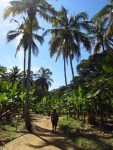
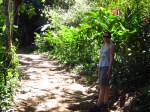
After crossing the bridge over the Minca River, we took the road to right and rode past the church and a few small market stalls set up under the trees. At the end of the strip of buildings, the road continued and was paved – or rather the two tyre ruts were paved. I asked mi novio what was up ahead and he didn’t know, so we decided to find out. We followed a 4WD ute with a bunch of Colombians in the back for a while and as the road got steep, bumpy (and unpaved) and too much for our little scooter with 2 passengers, we passed a group of people on foot. Clearly there was something worth seeing up ahead, but what, we had no idea so we asked. It turned out there were waterfalls.

I am a sucker for waterfalls. I really love them. Mi novio had no choice but to continue and I had no choice but to get off and walk a few of the steeper sections of road to avoid overheating our poor motorbike. After a good 20 minutes on the motorbike we came to the turn off to Marinka Waterfalls. A vendor was selling snacks on the roadside and as we stopped for a coca-cola I got bitten by tiny little mosquitoes which made me wish I had brought repellent as well as sunscreen. The mosquitoes only seemed to be at that one spot, and as we parked the bike and walked the last 400m to the waterfalls thankfully they disappeared.

As with most natural attractions in Colombia, you couldn’t just discover the waterfall in its natural setting. A couple of roofed huts have been added, with one serving a rustic set-menu lunch. I was pleased to be charged the Colombian entrance fee rather than that for foreigners. If I just keep my mouth shut and let mi novio do all the talking, I can often get away with this.

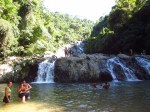
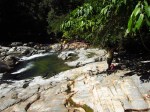
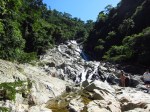
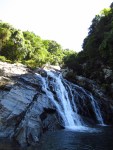
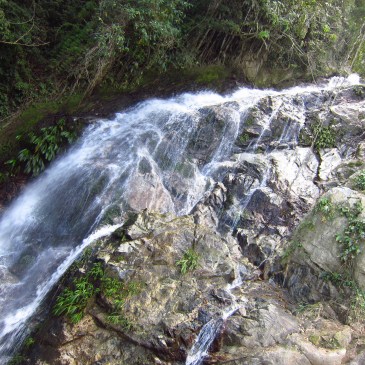
The waterfalls have two drops, a cascade of about 20m and a drop of about 10m, into pools that you can swim and relax in.

We didn’t really spend much time there, but had a bit of a swim and relaxed while marvelling over our random discovery because even mi novio didn’t know about this waterfall.

As we were leaving the site we came across four almost elderly people who we’d seen struggling at the turn off. They had walked all the way from Minca to the waterfalls and then refused to pay the entrance fee and so were turning back around. They argued that you shouldn’t have to pay to see nature and the guy collecting the entrance fee said that the site needed to be maintained. Whilst I agree with their sentiments,  I know it is common to have to pay. During my roadtrip in the US, I visited a lot of national parks and each had an entry fee (although buying an annual pass is much more cost-effective if you plan to visit a few US National Parks). However at the end of the day, I think if I’d spent an hour or more walking uphill in the heat, I would pay the small entrance fee to cool off rather than turn around in stubborn defeat.

This slideshow requires JavaScript.

~~~~~~~~~~~~~~~~~~~~~~~~~~~~~~~~~~~~~~~~~~~~~~~~~~~~~~~~~~~~~~~~~~~~~~~~~~~~~~~~~~~~~~~~~~~~~~~~~~~~~~~~~~~~

Want to go to Marinka Waterfalls?

What’s there: Waterfalls, swimming and a walk in the Sierra Nevada de Santa Marta

How to get there: Take a collectivo to Minca that leaves from Calle 11 and Carrera 12 near the Mercado in Santa Marta between 8am and 5:30pm (COP$6000, US$3.40), a mototaxi or taxi (COP$40,000, US$22.60 from Santa Marta). Cross the bridge over the Minca River and take the road forking to your right past the church. Continue following this road uphill for about an hour. Just after you ford the river, you will see a stall and signs to Marinka Waterfalls on your left. If the walk is too much, you can also hire a mototaxi from Minca to take you there.

Entry fee: COP$2000 per person (US$1.10) for Colombians or COP$3000 per person (US$1.70) for foreigners

Hike difficulty: Moderate. The path doubles as a road but the walk to the waterfalls is uphill.

Walk time: Approximately 1 hour from the church to the waterfalls.

What to take: Sandals or walking shoes, water, sunscreen, snacks, money, bathing suit, towel and camera.

Travel fantasy – erased

I’m not sure when exactly I stumbled upon the fantasy of owning a hostel, but I’m pretty sure it was either on my lap of South America in 2004 or soon after when dealing with the travel come-downs back home.

I fantasised about how cool it would be to welcome foreign backpackers into my hostel and make a place where they would feel at home and where I would meet amazing people from all over the world. I would put on barbecues and have a plethora of information on activities and local sights. They would smile and share travel stories. In my fantasy it would be amazing.

Mi novio and I have just finished a 10 day stint hostel-sitting where that beautiful little fantasy was shattered. How can it be so bad in just 10 days you may ask? Well on this green grassy side of the fence I never considered the following:

* You are chained to the property. Travellers don’t have weekends off. (Actually they do, but that’s from their work or whatever, not from your property.) You need to be there all the time, and if you’re not there, you need someone trustworthy to be there. Mi novio described it as being in a cage, or rather a prison, even more apt when considering the front gate with padlock that requires opening and closing for the inmates – oops, sorry, for the guests – at all hours of the day and night.

* Utilities are essential services and when they don’t work, you’re in the bog. Here in the land of Colombia everything is possible but nothing is certain. This includes water and wifi services. When there isn’t a permanent connection to a water service and you rely on the water company to release water to fill your tanks every week and it doesn’t arrive when you have a full house of guests and the reserve tank is empty you start to panic. Same when the wifi goes on the blink or decides to be super slow and all you can hear from the guests is a bevy of complaints about the internet connection you start thinking you’ll lose them all to the competition.

* Ah yes, the competition. Taganga is pretty much chock full of hostels, guesthouses and the like for people trying to find a piece of Caribbean dream. So how is this Colombian family run hostel staffed with people who have never backpacked in their life supposed to compete with the neighbouring resort of a hostel that provides everything a traveller desires. It can’t. Like mi novio described so accurately, it is one of the little fish that always hangs around the bigger fish to feed off the leftovers. When the neighbouring hostel is full, this hostel starts to get some lodgers.

* Sex, drugs and party time. They’re carefree and miles from home, but does that mean they can leave used condoms and smoked up joints on the serene rooftop terrace? No one wants to hear 3 different couples having sex in the one night. No one wants to open the door to a guest who is having sex in the morning light in front of the hostel. They may only be here for a night or two, but this is where you live and work.

Add a 6 month old pitbull that lives in the hostel and likes to go marauding in the middle of the night, eating Christmas decorations, remote controls and ripping open bags of rubbish to spread up and down the hallway and a complete lack of reservation and accounting system and we landed in the middle of complete chaos with a bang.

After 10 days of running a hostel we realised that despite meeting some great people and feeling good about helping them with their questions about things to see and places to go, we are not cut out for this lifestyle. In the 10 days we were at the hostel mi novio spent about 3 hours one night sleeping with me, all the rest were spent in the hammock in reception ready to open the door to all the party-goers arriving back at all hours of the morning. Both of us were well and truly ready to head back to Santa Marta and sleep uninterrupted in our own bed.

One of the best things I’ve come to realise though, is that we make a great team. I bring a number of ideas to the table and mi novio is the go getter who executes them. We think along the same lines and have the same philosophies when it comes to running a business but we have different skill sets. I think any business we have and put our energies into will succeed, it’s just a matter of finding the right opportunity.

However, I am now taking my hostel fantasy, wrapping it in threadbare hostel sheets and throwing it in a big garbage bag. It’s not my problem anymore if the dog gets to it.

Do you have a travel fantasy? Has it ever turned to reality and was it as good as you imagined?

Roadtrip to Quebrada Valencia

We finally stretched the legs of our new motorbike with a day trip to the cascades at Quebrada Valencia.

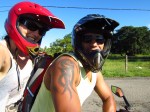
With $3 worth of petrol in the tank, we headed east along the Troncal Caribe in the direction of Riohacha. I am not the best pillion passenger as I have a tendency to dig my nails in and yell into the ear of mi novio should we approach other vehicles too quickly, go over speed humps (or dead policemen as they call them here) without braking, overtake trucks or buses and I curse and scream “I don’t like this” when we weave in and out of traffic. But, after leaving Santa Marta’s city limits, we were suddenly quite alone on a well paved highway and riding under a canopy of green forest.

The air was cooler and the scenery divine. The wind blew all of the weariness and frustrations of the city away. Instead of screaming in mi novio’s ear to slow down or pay more attention, I was conversing with him, constantly exclaiming “This is so lovely.”

While I marvelled over the scenery and breathed in the fresh air (any odd insect or two), I realised that it must be quite tedious listening to me rabbit on about the scenery when he has passed by this same route thousands of times for his work but he told me that it was a completely different sensation on the motorbike where you really feel your surroundings to that of watching out the bus window.

50km and a bit over an hour later, we arrived at Quebrada Valencia, with an internationally recognised tourist attraction brown sign announcing the destination. The entrance to Quebrada Valencia is right beside the highway with a small pull-in on either side, a local store and a market stall selling aqua socks to the Colombians from the interior who can’t bear crossing the river in their sandals or bare feet.

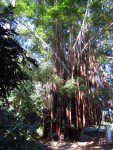
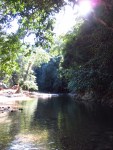
Quebrada Valencia, with its impressive range of cascading falls, is a 20 – 30 minute walk from the entrance and our first task was to cross the river. During dry season, the river is clear, shallow and tranquil, making the crossing (and subsequent crossings) quite easy. On the other side we passed by vendors selling coffee and fresh cooked arepas and walked alongside a banana plantation for a little bit. Not far into our walk we came across an enormous tree blocking the path, forcing everyone to walk around it. The tree has great clumps of root-like vines dangling down, and looks rather like you would imagine a tree relative of Mr Snuffleupagus from Sesame Street.

We continued our easy walk in the forest and crossed the river another five times to reach the lower swimming pools and rocky cascades of Quebrada Valencia.

It’s a popular spot for tourists and locals who take along picnics, and even their own hammocks. The falls drop over a rocky vein that obstructs the river’s flow and creates pools at different levels and some great jumping points.

We were instantly enamoured, and climbed the rocks to find a little ledge under a shady branch to leave our belongings while taking a refreshing dip in the rock pools and a slide down rocks beaten smooth by the water current. It is a great spot to relax and unwind and enjoy the company of family and friends. I couldn’t believe when mi novio said he hadn’t been there before. Not even on a family outing with his parents or with other friends.

Further up were more water pools and great views of each waterfall and all the way down to the end of the cascades, but we couldn’t climb up to the very top as it was cordoned off with plastic ‘do not enter’ tape and had a guy posted beside to enforce the no climbing rule.

After an afternoon of bathing in the lovely rock pools, we followed the easy trail back to the entrance and our motorbike, all the while exclaiming that we will have to bring D and la suegra here one day. Quebrada Valencia really is an all-round great day trip for lovers, families and groups of friends.

~~~~~~~~~~~~~~~~~~~~~~~~~~~~~~~~~~~~~~~~~~~~~~~~~~~~~~~~~~~~~~~~~~~~~~~~~~~~~~~~~~~~~~~~~~~~~~~~~~~~~~~~~~~~

Want to go to Quebrada Valencia?

What’s there: Waterfalls, swimming and a short hike in the Sierra Nevada de Santa Marta

How to get there: Take the Troncal Caribe from Santa Marta towards Riohacha by car or motorbike (parking COP$2000 – $3000 at the entrance) or by a public bus that leaves from Calle 11 near the Mercado in Santa Marta that also passes by Parque Tayrona (ask to be dropped at Quebrada Valencia) and then flag down any return bus.

Entry fee: COP$3000 per person (US$1.65)

Hike difficulty: Easy but must be able to cross the rivers, the walking path is flat and well looked after

Walk time: 20 – 30 minutes

What to take: Sandals or flip flops, water, sunscreen, snacks or money to buy from vendors along the way, towel and camera.

We have transport!

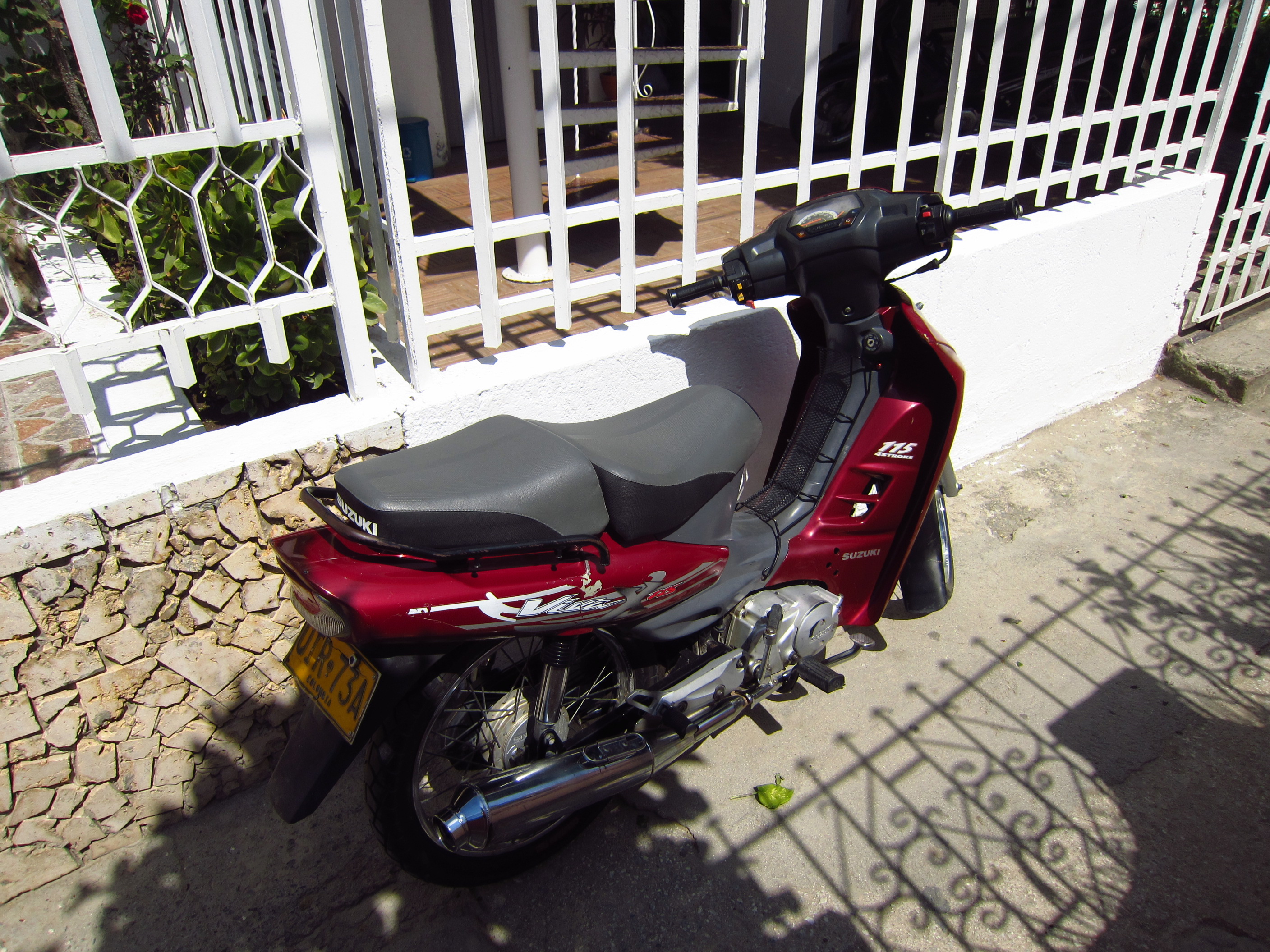
Our new motorbike
Red goes faster, but this colour in Spanish is ‘vino tinto’ or red wine. Let’s hope that means it’s a little more mellow than fast!

In Santa Marta there are more motorbikes than cars. As seems to be the case in many tropical areas of developing countries, the motorbike is the most prevalent mode of transportation.

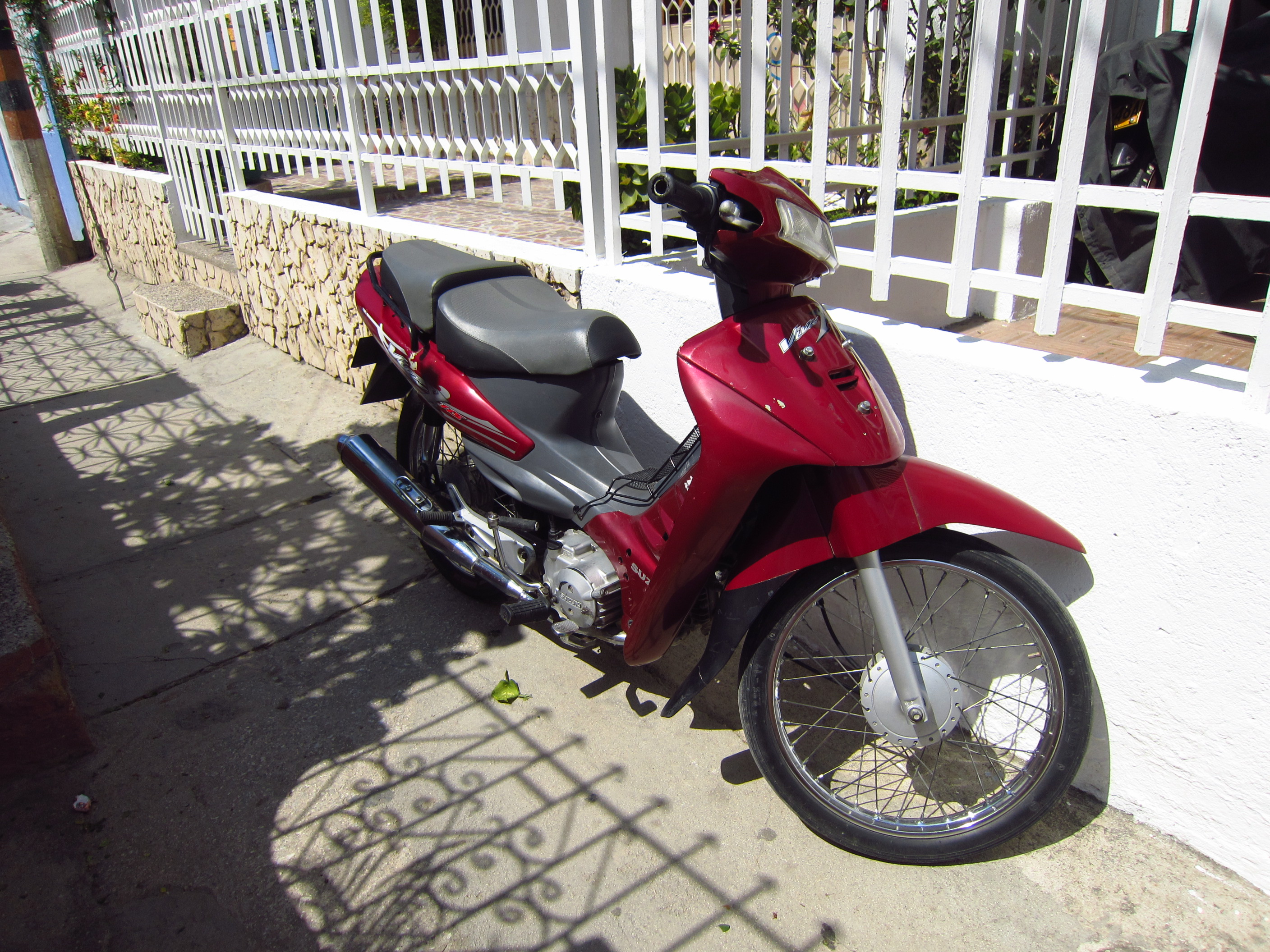
Today mi novio and I join the ranks of transport owners after buying a second-hand Suzuki motorbike, or as I’m accustomed to calling it, a scooter.

Coming from a country where the majority of people have a car to a place where the most common forms of transport are buses, taxis and mototaxis (motorbike taxis) has been an interesting change. Not everyone here has their own transport and it is still a dream for many people to have a motorbike and even more so, a car. I’ve come to realise how important transport, and lack of transport, is to lifestyle and culture. For many families even a local bus fare stretches the budget very tight.

I can’t count the number of times I took for granted popping to the supermarket or shops only to come home with a heavy load of groceries or a armfuls of shopping bags. That was when I had a car to haul my goods. Going to the supermarket here for a ‘big shop’ to stock up on bulky and big essentials such as washing powder, sugar and rice means having to pay a taxi fare to get home as it’s too far to walk carrying plastic shopping bags. The taxi fare is dirt cheap by Western standards, but constitutes a fifth of the daily minimum wage. No wonder the vast majority of families sh0p daily at their local corner store, buying only the quantities necessary for the day.

Our new motorbike
Our new motorbike, yet to be named…

Having a motorbike now means we have freedom. We can go to the beach without having to catch two buses. We can look for an apartment. We can visit family and friends (when I make some!) and we can go to the supermarket without having to take a taxi.

Mi novio has such a big smile on his face today. He’s so excited to have a motorbike and our own mode of transport. I’ll still use the bus regularly to get to the city centre because it is

convenient, but I’m looking forward to discovering more of Santa Marta from the back of the motorbike.

Back in Colombia

We’d kept it a surprise. No one in Colombia knew we were coming back earlier. They were all awaiting our arrival on the 21st of October.

The decision to come back sooner came from an intersection of a few thoughts and feelings. Mi novio missed his family. He’d been away from them for 4 months and he was keen to see them again. The travels we were doing in Argentina and Chile just exacerbated his desire to go  get back on home soil. We also realised we were spending far more than we had budgeted. I had underestimated how expensive it was for two people to travel.

Unfortunately to change our flights was also super expensive. We virtually had to forfeit our flight and buy new ones. So we looked at travelling to Colombia by bus. Money can be a strong motivator and in a move away from my normal logic, mi novio convinced me that taking the bus was a sensible financial option and that it wouldn’t be the nightmare of my imagination.

After 11 days en route from Argentina, 4 border crossings and 7 nights sleeping in buses, we arrived to the tropical heat of Santa Marta.

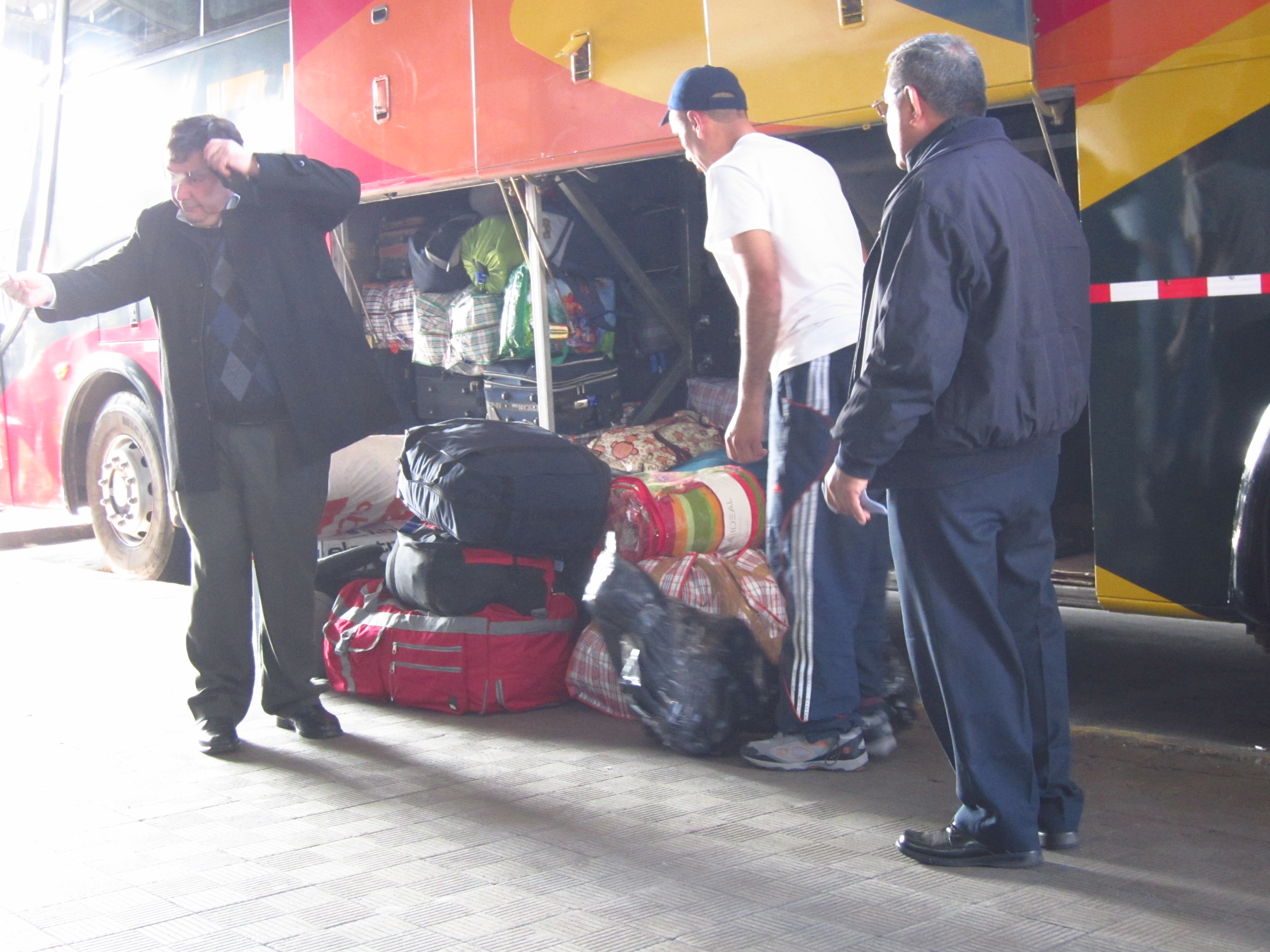
Loading bags in Chile
Loading bags in Santiago. Even an excess baggage charge doesn’t compel people to travel lightly.

Laden with 2 suitcases, 2 large backpacks, 2 small backpacks and a carry-on bag we walked the narrow street to mi novio‘s house and opened the gate. From inside the house there the was a flurry of excitement and shouts as the realisation of our early arrival dawned.

Almost two weeks after arriving and with the flights we have booked set to fly tomorrow, I can look back and say it was a good decision to come back earlier than planned. What we’ve accomplished in this time here and the money we’ve saved are just two small benefits when compared alongside the reunion of family and the happiness I saw on his son and mother’s faces.

Although the 11 days of travel and 7 nights in buses faded into a distant memory as soon as we left the bus terminal in Santa Marta, it is an experience I am not keen to repeat and I still think we are slightly crazy for giving up the airfares that would have got us here in 8 hours.

~~~~~~~~~~~~~~~~~~~~~~~~~~~~~~~~~~~~~~~~~~~~~~~~~~~~~~~~~~~~~~~~~~~~~~~~~~~~~~~~~~~~~~~~~~~~~~~~~~~~~~~~~~~~

Are you also looking to do an international bus trip in South America?

Here’s some details of our trip to help you out.

Buenos Aires, Argentina to Santiago, Chile > approx 19 hours. Most companies offering this route stop in Mendoza. Cata Internacional has a daily direct bus. We took Pullman Bus which leaves Sundays and Wednesdays and was $450 Argentinian Pesos each (other companies quoted $500 pesos). This was probably the most attentive service we received on the buses. We were plied with coffee and soft drink, given a snack sack, dinner was provided in a restaurant and a ham and cheese sandwich provided for breakfast and there were good, new release movies shown. The seats weren’t as comfortable as some of the others but we were provided with a pillow and blanket. Our tickets said we could take 20kg of luggage each, but this was not weighed. Note: We went to Santiago to pick up luggage we’d stored and there are direct buses to Lima from Buenos Aires.

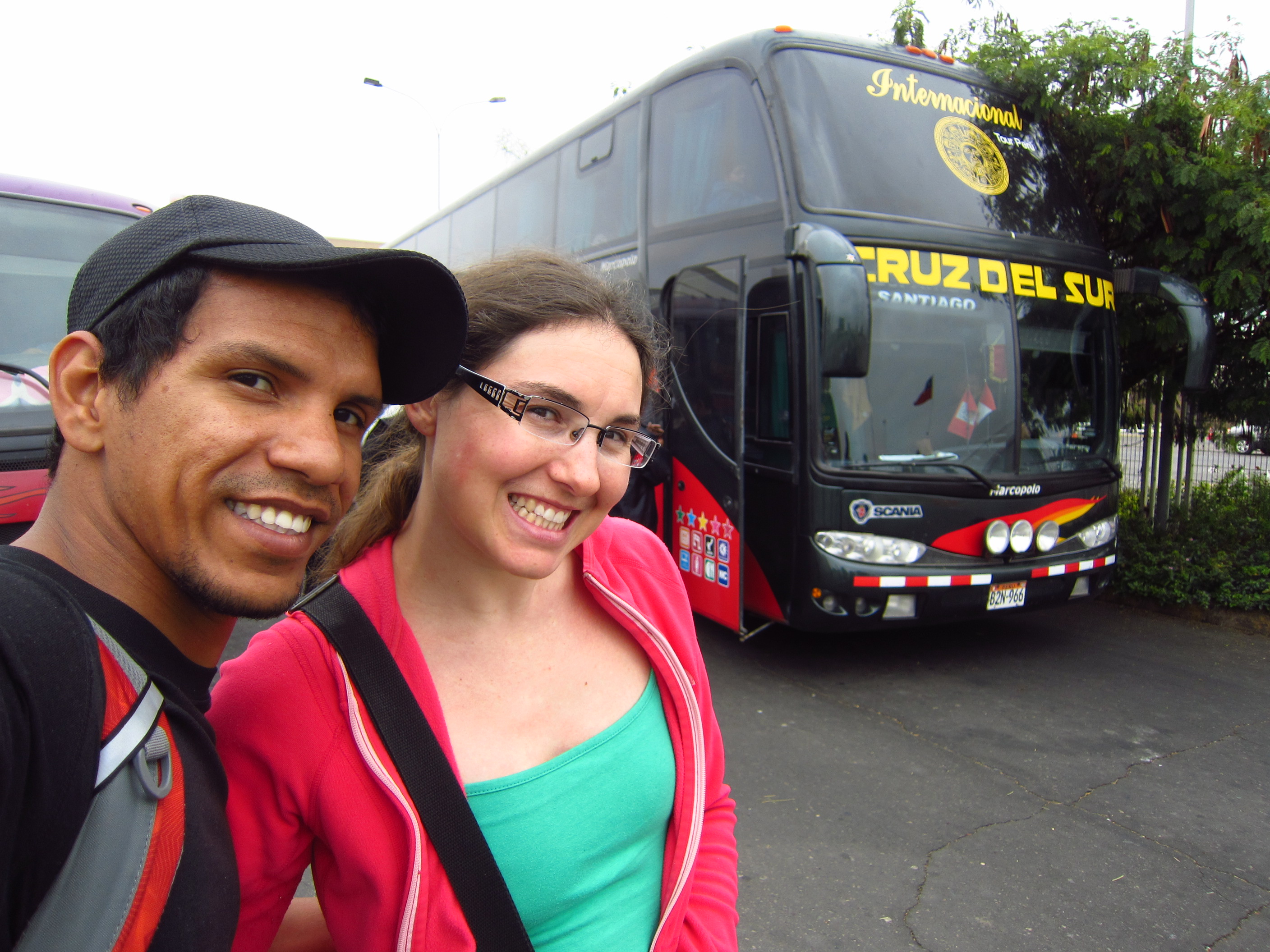
Cruz del Sur bus
Crossing the Chile/Peru border.

Santiago, Chile to Lima, Peru > approx 52 hours. There are a few companies (Cruz del Sur, Ormeno, Andesmar and more) that offer this service, although they all operate on different days. We went with Cruz del Sur and paid $40,000 Chilean Pesos each. We chose Cruz del Sur for the departure day and also because they provided service on board the bus and most meals and also for the baggage allowance of 30kg. The bus companies seemed to be stricter on overweight baggage than airlines, and we had to pay 800 Chilean pesos for each kilo overweight. I would definitely recommend Cruz del Sur as we received very good service from the dedicated waiter who always advised us 10 minutes before we were to stop and told us how long we were stopping for. He also kept the movies going back to back during the trip and showed a good variety of new-release films (ie not just action films!) and he was also helpful at putting on the English sub-titles when I asked. Blankets were provided. Cruz del Sur have a connecting service to Guayaquil, Ecuador if you are heading further north.

Onboard Ormeno
Enjoying the space on the bus after most passengers got off in Cali.

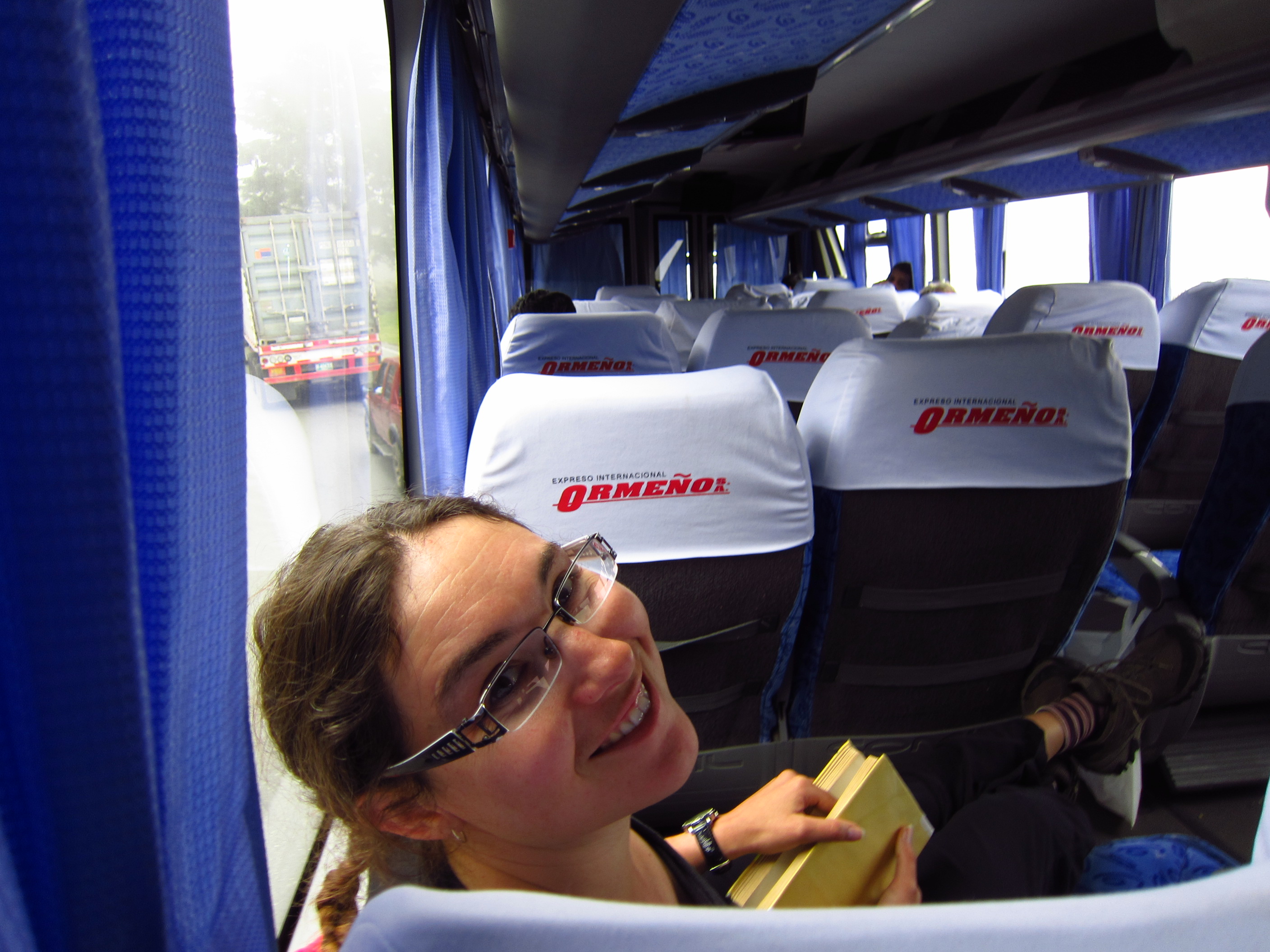
Lima, Peru to Bogota, Colombia > approx 76 hours. There weren’t as many operators as we had expected, and since Lima doesn’t have a central bus terminal, it’s even harder to find them. In the end we had to go with Ormeno despite having read bad reviews online and hearing that it is just a bus trip, there is no service included. We paid US$180 each (you can withdraw US dollars from ATMs in Lima and there is an ATM inside the terminal. This did not include any meals. The bus stops at various places for you get off, go to the toilet for number 2’s and eat. Two drivers completed the entire distance and they were drivers only. They didn’t advise anything about how long each stop was for and were rather surly when asked anything. The seats were the most comfortable of all the trip with a pillow top cushion. However there are no blankets or pillows provided for a journey of 3 nights (this bus also stops in Guayquil and Quito, Ecuador and Cali in Colombia and some days has an onwards service to Venezuela). We were also only allowed 20kg of stowed luggage and 6kg hand luggage. Each extra kilo was charged at US$1, however they were slightly less precise about the weighing process and didn’t charge us for the full overweight baggage we had. Ormeno definitely wasn’t as good as other companies and the movies were sporadic and seemingly of the one genre, but also it wasn’t completely horrible.

Teary farewells

It’s so much harder to say goodbye to loved ones when you don’t know when you’ll see them next.

The final week at home was chaotic, stressful and packed full of preparations, not just for mi novio and I, but for Dad’s birthday party which was the day before we flew out of Mildura.

I really can’t believe how much paperwork and sorting out of affairs is required to go overseas for an indefinite period. I had so much stuff going on and unfortunately had left some of it way too late to get finished. However I was far more packed up than when I moved to LA last year, where I pretty much walked out of the house with everything I’d left behind in the same spot. I got more ruthless this year. I took more to the op shop than I have in all my combined visits before. I threw out mountains of irrelevant papers and organised the remainder of everything into several plastic containers

Dad’s party was a good opportunity to bid farewell to family and family friends. I was upset that one of my grandmothers couldn’t make the trip to the party and so I missed saying a proper goodbye to her, although she rang me to wish me well in Colombia.

On our final day at home, we got busy packing everything properly. I already knew I was going to be a bawling mess when saying goodbye to my family, and even typing this now brings tears to my eyes and a sob to my throat.

We had a final barbecue with Mum, Dad and my siblings, soaking up the beautiful day, before some photos and the farewell to my siblings. Whenever each of them would start to say bye and reach for a hug, fat tears would start rolling down my cheeks. I’m going miss them so much.

At the airport we checked in our mountain of luggage and then a parade of family and friends started to arrive to see us off. As the boarding time was announced, I started my rounds of everyone, hugging and kissing goodbye. I was just saying how I hadn’t got to farewell my grandmother at the party the day before, which started to add to my level of upset-ness, when her and my grandfather rounded the corner, just in time for me to give them a big hug.

Lastly, just before we left to board the plane we farewelled Mum and Dad, who have been just marvellous. They have done so much for mi novio and I these past two months and I enjoyed being back home and helping out. I am going to miss them desperately. But they are planning to come and visit us in Colombia, and hopefully we can get back home for a visit within two years.

All I can say, is thank goodness for Skype. It certainly makes being on the other side of the world to your loved ones so much easier.

A sad flight

While waiting at the gate to board my flight from Miami to Bogota, I noticed quite a lot of airline staff milling around and donning yellow hi-vis vests.

A little later a lady came over the PA and said “You may have noticed a number of agents here today. We are here because we lost an agent.” She then needed to recover for a moment, and continued with “and she is returning to Colombia today.”

Around me other passengers were looking about in that unsure manner about what had just been said.

As the plane left from the gate, more than 20 staff members stood on the apron watching the plane depart. Some were waving, others stood resolute. It was very sad. I felt very sad and that it was tragic, even though I didn´t know the name of the girl or the circumstances surrounding her death.

Later, as we were about to commence our descent, the pilot asked for us to all observe a moment’s silence for the girl whose remains were being transported back to Colombia.

It made me wonder how many times I´ve been on a plane carrying a body home. You would never even know.

Next destination, Colombia

Words cannot begin to express how excited I am to be going to Colombia.

Firstly there is the yearning for travelling in Colombia that I’ve had since April 2004 when I was in the tiny jungle border town, Leticia. I made a vow to come back and now it is finally happening. Initially I told myself I wasn’t removing the red, blue and yellow wristband I bought there until I returned, but after going home and getting a professional job, that had to come off. But has been with me all the time hanging from my keychain. So as you can imagine, I’m really excited to see that dream come to life.

Secondly, I have had my fill of the US. After 6 months here I am desperate for some new scenery and culture. I think the longer I stay here, the less I like being here. Despite all the wonderful people I’ve met, and the places I’ve enjoyed as I crossed the country, I just don’t like being in America.  It’s a strange feeling that’s hard to describe. There’s something that makes me feel uneasy, and then there’s so many things to appreciate about Australia that you only pick up when you speak to people about how it is here, like annual leave, maternity leave and health care.

Whilst I feel like this now, I also know that I will be back and travelling in the this country in the future because I want to revisit the friends I’ve made and also see the things that I missed on my planned return leg like Niagara Falls, Chicago, Mt Rushmore, Yellowstone, Glacier National Park, Olympic National Park, Seattle, Crater Lake National Park, Portland and Yosemite. It’s just that next time will be for a much shorter period of time, and hopefully with a friend.

Blue Ridge Parkway

One of America’s best scenic drives, the Blue Ridge Parkway is a narrow, winding road at the top of a mountain range. It offers spectacular views and some great things to stop off at along the way.

It’s about 400 miles long, but I only drove the North Carolina part and skipped the Virginian part. There’s only so many scenic overlooks you can be inspired by and as beautiful as winding roads are, they are also very tiring to drive.


Esmeralda’s tune-up

Driving past a Volvo dealership in Asheville, North Carolina, I decided it was time for a little tune-up after more than 6000 miles on the road. I was lucky to be able to walk in and get her an appointment where she got a new headlight. I hadn’t even noticed that a headlight was blown as I haven’t been doing any night driving. When I realised that, I thought it sounded a little strange to me. Two months on the road and virtually no night driving. I sound like a nanna.