A Baptism

We received the invitation to be the godparents of Edwin’s nephew by WhatsApp while visiting the monastery near Villa de Leyva with my Mum and sister. Edwin wanted to respond straightaway and pressured me for a response, when I just wanted to have a discussion in private. Surely receiving an  invitation by text message rather than a phone call is an indicator that an instantaneous response is not required.

I never expected the privilege and to be honest I thought our duty was done when one of the two names we suggested for the baby was selected. I can’t say I was overly keen to have this responsibility.

Anyway, an enthusiastic Edwin responded with a phone call to the affirmative, only adding “it’s an honour” as I wildly gesticulated that he needed to include that phrase for politeness sake.

We didn’t hear anything about the baptism for a while after that, not until Edwin and I were chatting about the looming date and I said that his sister and brother-in-law had to check with the priest about the requirements and that they needed to know that I’m not Catholic, because imagine if I turned up to the baptism only for the priest to say the godparents had to be baptised and confirmed Catholics. I was also not willing to perform any kind of religious act to turn me into an eligible fairy godmother should this have been the requirement for the job. My thoughts on religion are at opposition to my spiritual beliefs and I was not disposed to put myself into a hypocritical position solely to appease others no matter how many family feathers it would ruffle. As it turned out, there was no issue with my non-Catholickness at all.

On the day of the baptism we raced back from having our hair and nails done in town to meet with the priest at 2pm prior to the 3pm baptism. We were 15 minutes late and the priest was nowhere to be seen. Edwin’s brother-in-law put in a call to him only to be told that he would be an hour late, and therefore also late for the start of the baptism.

My anxiety levels were probably the highest at this delay, although the Colombian anxiety was regarding the possible lateness of the start to the birthday slash baptism party at 4pm and the concern that guests would be turning up to the party and we would still be in the chapel. I couldn’t quite grasp this reaction, as surely the party invitees had also been invited to the baptism and would be in the chapel with us. If this wasn’t the case, then that is like rocking up to only the wedding reception and not the ceremony – plain rude.

While we waited, we went to check out the party site where the decorators were no more advanced than before we had gone to the beauty salon. They had been there since 6am, supposedly to decorate, but what they did could have been done in 2 hours, maximum 3 hours. It’s another shining example of wasted efficiency and perception. The party place sells the decoration and entertainment package saying that the decorators will spend 10 hours decorating the venue to your theme, instead of just saying “we will decorate your venue for $X” and then send the decorators out there for 3 or 4 hours and then to another party for another 3 or 4 hours that they could make more money from. Because of the apparent ineptness, I’m also sure that the impressive George the Curious balloon tree filled with cute balloon animals came ready made from the shop, as the decorating guys couldn’t keep the other balloon bouquets from escaping in the wind and popping on the grass.

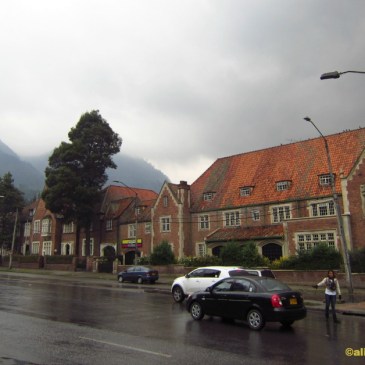
At 3pm we drove up to the chapel to greet arriving guests. After almost three years in Colombia I still have the foolish expectation that people will arrive on time for important events, yet Edwin’s brother-in-law’s family only arrived at 3:30pm. It didn’t matter anyway because the priest didn’t show up until 4pm, and dispensing of any pleasantry or need for consultation with the baptism’s protagonists, went straight to put on his robes and then called the parents, Edwin and I to the front and launched straight into the ceremony as though the devil was snapping at the heels of the toddler.

I’d never even been to a Catholic baptism and all of a sudden I found myself a participant in one, in another language to boot. I had been counting on the pre-ceremony pep talk with the priest to help guide me through the experience. Thankfully the priest was very instructional about what to do. He told us ahead of a passage that we had to say “Si, renuncio” or “Si, creo” and thankfully I understood when I had to make the sign of a cross on the toddler’s forehead. I also think that most people would recognise the Lord’s Prayer in any language just from the melody of the lines. It was over in 15 minutes and then we were rushed to the priest’s office to provide our names for the baptism record where the most conversation we got was when the priest asked if Edwin and my sister-in-law are siblings after seeing the identical surname structure.

It was then off to the party to sit awkwardly in rows around the perimeter of the open-air venue and watch the children’s activities and entertainment. At any Australian kids birthday party, the parents will mingle with others and the parents of the birthday child would introduce people to each other, with the children’s activities not necessarily the central focus for the adults, however here, once you had a seat, that was it and adults only spoke to those either side of them. I didn’t even see my sister-in-law go around and talk to the parents of the invited children. Come to think of it, at an Australian party, there is always a food and drink table, where while a plate may get passed around every now and then, each guest can go to the table for a nibble or a top up and circulate. The seated and served nature of a Colombian party is far less sociable.

Balloon tree
The sad story of the balloon tree

Just before the parents gave their speeches of thanks, the pinata came out. I always thought a pinata had to be whacked with a stick for all the lollies to come bursting out, but in this case, the contents of a container were tipped over the kids’ heads and they were sent scrambling for a prize amongst the confetti and streamers. Once prizes were claimed for those lucky enough to have snatched one up, the kids started sweeping around on the floor with the contents of the pinata and it was precisely at this moment that they turned into destructive little feral monsters pulling all the animals off the balloon tree and then pulling the tree apart. It was as though a consolation for not getting a pinata prize was a balloon animal. Perhaps it is mean-spirited of me to have described the children like this, but I wanted that balloon tree and its animals to go home with my godson.

In the thank you speech I got a special mention. I hadn’t expected my foreignness to still be such a novelty within the family, but Edwin’s brother-in-law said “We are very proud that our son’s godmother is from Australia, and that is very cool” at which there was a ripple of excitement through the crowd and one blushing face in particular.

The special treatment continued when at the family dinner held afterwards, I was ushered over to be introduced to my brother-in-law’s colonel while Edwin was left to cut the cheesecake that I, in all my BYO Australianness, had brought to share (something else that still sticks with me despite the only obligation to bring to a Colombian party is a gift).

The next day before heading back to Bogota we went to see the duplex that my sister-in-law and her husband have bought and will move into after he retires from the army. The current tenants were in the middle of moving out and were trying to figure out how to load the fridge in the back of a ute when Edwin’s brother-in-law waved to me “Camille, come in and have a look”. Edwin, standing right beside me, just looked at me with a wry smile, wondering when my celebrity would fade and that he would finally get a look in as the valued godfather.

Are you a godparent? If so, I’d love for you to share your thoughts on the role and its responsibilities. 


Published! In Was Gabo an Irishman?

Towards the end of last year I received an email with an invitation to submit a story for an anthology of essays by foreigners uncovering how the works of the great Maestro, Gabriel Garcia Marquez, had shaped their opinions of, or revealed to them, the real Colombia.

I was very excited and immediately knew that I wanted to write about the magical realism of life in Santa Marta that I’d seen firsthand when I first moved to Colombia.

At around the same time I participated in a workshop as part of my work where visiting professors from my home state of Victoria delivered a capacity building program to Colombian PhD supervisors and doctoral candidates. While I fit into neither of these categories, I found the program informative for my work and quite motivational for my personal projects, particularly the piece about writing a thesis or a journal article, and the work involved to craft the story in a coherent way, and tips for making time to write.

I told the professor, Ron Adams, about the invitation and he was very encouraging. And so I started to write. I planned out the story looking at what I wanted the overall theme to be, and also made a list of the anecdotes I wanted to include.

Despite not sticking to my writing plan for a number of entirely valid procrastination excuses, I managed to finish my story and submit it from a hotel in Chile right on the deadline with a mixture of triumph, anticipation and guilt at not having kept to my plan and submitting something that wasn’t quite as polished as I had hoped – but then is it ever really going to be perfect?

In January I received the exciting news that my words would be published, not just virtually on my blog, or in some dull work report, but actually in printed in ink and bound into a book that would be for sale. My story about the beliefs and superstitions I lived amongst in Santa Marta was going to be included alongside two dozen other writers. As I told Edwin that my story was going to be printed in a book, he was very excited, although his excitement grew even further when he learned that he was my muse and that his name was going in print as well.

You see, as we discuss the pros and cons of starting a family together, it is Edwin’s strong desire to leave a legacy behind. He wants our story to be handed down and for our genes and surnames to entwine into a living breathing person. That is the legacy he wants. I think it is quite a common sentiment for many people, however I am not one of them. I don’t see numerous offspring as perpetuating my impact, or importance, in the world after I am gone. It’s not how I need to be remembered. I’m not sure that Edwin’s mind will be changed, even now that our love story is written down and published and being read by thousands of strangers, yet for me, this is more like what my legacy looks like.

I’ve never written down our story before, not even here. I have often thought about writing a post describing how we met, and I’m sure there’s a draft started somewhere but the perfect public forum for telling it was meant to be in the book Was Gabo An Irishman? Tales from Gabriel Garcia Marquez’s Colombia. We each have our own versions of telling the story of how we met and fell in love, each weaving different threads together and elaborating it with our individual recollections, yet the stories are very different in English and Spanish which is what I guess makes it fabulous as an oral history.

I’m seven stories away from finishing Was Gabo An Irishman? and I know that when I finish it, there will be a sadness because there will be no more incredible personal stories to absorb, admire, amaze and relate to in the accuracy of their observations.

My great thanks go to the editors and founders of this wonderful project, Caroline Doherty de Novoa, Victoria Kellaway and Richard McColl. They have pulled together all these people with interesting stories to tell and have done so in a polished and professional way. I know my story is far better for their insightful comments and fabulous editing and I’m really very chuffed to have my writing alongside such talented and accomplished people.

So now the only thing left is for you buy a copy and read not just my story of falling in love with Edwin and Colombia, but all of these wonderful tales of love, war, magic and most of all, real people.

From overseas you can purchase a copy of Was Gabo An Irishman? via Amazon at this link and by clicking through you can also read a far more enticing description.

In Bogota, the book is available at:

La Madriguera del Conejo bookshop, Carrera 11 #85-52

The Book Hotel,  Carrera 5 #57-79

If you do buy the book, I’d love to hear your feedback!

And as a final note, I’d like to share the fabulous quote preceding my story Bewitched in Santa Marta on page 187.

Crazy people are not crazy if one accepts their reasoning. – Of Love and Other Demons


A crazy day of Colombian cliches

Yesterday was one of those days where there are so many observations to make about Colombia and Colombians. Even if my phone had enough memory for a Twitter app, I wouldn’t have tweeted this, but let’s just say that if I had live-tweeted yesterday, it would have looked something like this:


12:55pm – Gooooooooooooooooooooooooooooooooooooaaaaaaaaaaaaaaaaalllllllllllllllllll #Colombia

1pm – A little loco comes running into the bedroom screaming and yelling. He flies on the bed and appears to be having some kind of fit.

1:02pm – The little loco starts jumping on the bed brandishing pillows and repeating “Gano! Gano!” (They won, they won)

2:05pm – Time to get ready to go to a family birthday party at the opposite end of Bogota #familycommitments

2:10pm – I want to wear a dress, but everyone else will be in jeans so I guess I’ll acquiesce

2:25pm – On our way to the #Transmilieno station

2:29pm – We need to buy a present, chocolates from Carrulla

2:31pm – Uh oh, looks like some kind of riot ahead.

2:32pm – It’s a sea of yellow shirts throwing cornflour and spraying silly string everywhere. How do we avoid this?

2:33pm – They are blockading the road, there are traffic jams, beeping horns, mess and people cheering

2:33pm – What?!? They are even spraying foam into rolled down car windows #chaos

2:35pm – I’m told a gaggle of people on the median strip are surrounding a woman hit by a car #sickinthestomach

2:37pm – The pricing on supermarket shelves rarely matches up with the product. Where are the  $18,000 chocs?

2:40pm – Oh great, #cardrejected. x2

2:41pm – Now we only have about 15,000 pesos and we’re going to the boondocks. I need emergency taxi ride money.

2:43pm – Taking the side route to avoid the #crazyColombians and to exit unscathed

2:43pm – Feel sad for the woman being stretchered into the ambulance #sickinthestomach #nosyonlookers

2:46pm – These Colombians are #outofcontrol. It’s mayhem in the streets

2:46pm – Police are out n about but so many people yelling, cheering and blowing those horrible horns

2:48pm – I don’t feel very safe. What’s it going to be like at the other end of #Bogota?

2:49pm – Made mi novio call his aunt for an update on the situation in Bosa

2:51pm – Made him call again to ask how far we have to walk from the last bus stop

2:51pm – Okay, it’s just a block. I guess that should be okay #stillfeelinguneasy

2:54pm – Phew, card worked at #Bancolombia. Now we have emergency taxi cash.

3pm – Hand over $50,000 and my card at the Transmilieno stop. Teller shakes her head. Can’t hear over the noise

3:01pm – Apparently this station doesn’t recharge cards. #cranky #whydidtheymakemebuyonethen

3:03pm – Which bus to Las Americas? #Transmilienoconfusion

3:04pm – Darn, the F14 just passed.

3:04pm – The F14 doesn’t stop here. Just get on the next one.

3:10pm – Change here or at Jimenez? Yes, no, yes, no …. get off!!

3:10pm – F14 right behind. Woohoo! Seats for all three of us #Transmilienomilagro

3:20pm – We’re practically the only people on the bus not wearing yell0w jerseys

3:25pm – Street watching on the way south. Mostly quiet, most shops closed. #ChaosOnlyInNorth

3:45pm – The centre is also full of #crazyColombians

4pm – Passing Pradera outlets. I want to go shopping!

4pm – Haha “Pradera Outlet Factory” jajaa #Englishclasses

4:15pm – Finally we are arriving at Portal Las Americas. Long way from home.

4:16pm – I love that the feeder buses are called ‘alimentadores’. Obvious translation, but still sounds cool.

4:16pm – I didn’t think Colombians knew how to line up neatly and patiently for a bus #Transmilieno

4:20pm – Here’s our bus. We’re not going to fit.

4:21pm – We made it on, no seat. #squishy

4:24pm – This road is worse than the 4wd track to Ciudad Perdida. #hugepotholes #ridiculous

4:30pm – Feeling #claustrophobic. I don’t know how so many people do this every day. #Transmilieno

4:32pm – D just called it Transmi Lleno (full) #jajaja

4:40pm – Esta vaina es leeeeeejos

4:43pm – I wish we had left earlier. #readytogohomealready

4:51pm – Patience has just about to run out. Let me off this bus!

4:53pm – I think this is our stop. Get off. Push, shove.

4:55pm – Where is the building? #neverbeenherebefore #endoftheearth

4:55pm – I think we got off a stop too early. #walking

5pm – Me: what’s the birthday lady’s name? Novio: I don’t remember. What? She’s his step-grandmother.

5:01pm – This is it. Entering the conjunto and chasing down the rellies ahead.

5:01pm – Who’s that in the green #dress?

5:03pm – Sister-in-law looks fab in a dress. Never seen her in one before. #wishIhadwornadresstoo

5:05pm – The reception room is set theatre style #weird #antisocial

5:06pm – Greetings and kisses all round.

5:07pm – The birthday granny remembered my name. Still don’t remember hers. #Awkward #justuseSenora

5:11pm – 2 month old baby thrust upon me by the mother. #justrollwithit

5:13pm – Am told that #babies like me. Waiting to hear the usual question…

5:14pm – When are you going to have a baby? #unavoidablequestion #notodavia

5:20pm – Staring at the fields & mountain out the window #Bogotacitylimits #woopwoop

5:24pm – Food or drink haven’t been served yet. #onColombiantime #neveranynibbles #setplan

5:35pm – Found out that we will be having #lechona. Yum. Spit pig stuffed with rice & meat. #crackle

6pm – Mariachi band! #morepopularthaninMexico #thereisamariachiwoman

6:03pm – Mariachi guitarist’s white pants are very, very tight.

6:30pm – Still no drinks. Novio’s gone to the shop.

6:38pm – OMG I think a #priest is here to give #communion

6:38pm – He just put a robe on over his party outfit

6:40pm – Have never heard of #communion at a birthday party. Wonder if he’s taking confessions too

6:49pm – It appears he’s the nephew of the birthday granny

6:49pm – And he’s giving a #mass not just communion! #catholicism

6:52pm – Is it rude not to stand and kneel when everyone else is? #notcatholic #canIpretendIdontunderstand

6:55pm – Talking about the great mystery of God being 1 but 3 different things & and the message is we can be different but unified

7:04pm – Birthday #mass is over. Now the babies are being blessed.

7:20pm – #Lechona is being served.

7:45pm – We got served last despite being closest to the kitchen 😦 #lovelechona

8:05pm – Meeting more extended, removed and estranged family members. Colombian families are confusing.

8:20pm – Hometime. Getting a lift with the bro-in-law. #awesome #lucky #nonightrideTransmilieno

8:30pm – Birthday granny was a nun for 20 years! #thatexplainsthemass

8:31pm – Happy 80th birthday Dona Elia!

9pm – Family commitments met for a little while. #happyColombianfamily #phew


World Book Day & What I’m Reading

AmorToday is World Book and Copyright Day, promoting reading, publishing and copyright and also Spanish Language Day so while I listen to the live streaming of the national Gabolectura a simultaneous reading of Gabriel Garcia Marquez’s No One Writes to The Colonel across Colombia’s libraries, plazas and parks – I figure it’s a good time to share what I’m currently reading in Spanish.

I’ve written before about the disappointing lack of a reading culture in Colombia, yet the death of the nation’s most famous author and Nobel Prize in Literature winner Gabriel Garcia Marquez last Thursday has catapulted literature and reading to the front page and top of mind in all Colombians. In response to the passing of this national icon (although he lived in Mexico) the country is in mourning and the government has organised a week of activities celebrating his life and literature. One of the initiatives is today’s national reading of his novella No One Writes to the Colonel and giving away over 12,000 copies of the book to promote reading and to encourage families to read aloud. So great is the movement that mi novio, who rarely picks up a book, has said that now he wants to read Gabo’s most famous work One Hundred Years of Solitude. I hope he will, and I hope that it encourages others to read his work and savour delicious descriptions and eccentric characters. I know am.

I have to admit to reading very little apart from the newspaper in Spanish. When I read novels I like to devour them and reading in Spanish is a much slower process for me, however I like to always have a book in Spanish on the go alongside another in English. For Christmas mi novio gave me Amor by Isabel Allende. It is an anthology of stories of love in all its forms with a personal commentary and Isabel’s own memories followed by selected passages from her books. I think it is the perfect format for non-native Spanish speakers and it definitely suits my reading style in Spanish as it includes short excerpts from books I’ve already read in English and I can easily pick it up and read a few pages and put it down again without losing the sentiment between readings. It’s also nice to know I’m reading her actual words and not those of the translator interpreting her phrases into English equivalents.

So, while I’m reading a book in Spanish by a Chilean author on this day of international celebration of books and Spanish language, I’d like to encourage you to add a book by a Latin American or Spanish author to your reading list and open your mind to another perspective.


A report card & maths class

Sheldon would have been horrified at the parents meeting today.

Today was the last day of school before a week of holidays for Semana Santa (Holy Week / Easter) and so the parents were invited to the school to receive first term reports.

This is the third parents meeting for D’s Grade 5 class I’ve been to this year, the fourth when you count the farce of a Parents Council meeting during which I wrote furious notes about the principal’s narcissism, the complete lack of explanation of the role and frequency of Parents Council meetings, the disorganised elections of committee representatives, the vast quantity of parents who hadn’t finished school and wanted to return to study and the principal’s complete lack of ethics in naming people for whom the parents should not vote for in elections for mayor of Bogotá. I had intended for those notes to become a blog post, but they are probably too harsh and the summary above should be enough to give you an indication of my shock at how I’ve found Colombian government schools to be.

Usually we are only told the evening before that there is a class parents meeting in the morning, but for this one we had a week to program activities to ensure our attendance. I am the one who has been to every single parents meeting because they always fall on one of the three mornings per week that mi novio has classes. His cooking school is expensive and he can’t afford absences, so I am the sole representative from our family, which is a bit scary because I don’t always understand every nuance and struggle to hear what the teachers are saying because of distracting background jabber. (Second language speakers will know it’s so hard to focus on what is being said while in a noisy room).

In each of the three class-based parents meetings, the male teacher has said the same thing:

“We Colombians lack reading comprehension because we simply don’t read. This isn’t just our fault here in the class or at home, it is a cultural thing. Children will mimic the behaviour of their parents, so if they don’t see their parents reading even a newspaper, they won’t read themselves.”

Now that I’ve heard that for the third time I realise the teacher gives the parents an out for why they don’t read, or think that reading is important, although he did ask how many parents had thought to give a book instead of a toy. I am a big reader. I’ve always loved reading and stayed up late to finish chapters. I remember once in Grade 3 (about age 9) I was reading a Babysitters Club book on the bus. A Grade 6 girl came up to me and told me I was too young to be reading a book that thick. Thankfully I didn’t let that criticism stop me and went on to collect 40 more Babysitters Club books up until I grew out of the girls’ antics. Anyways, instilling an interest in reading in D is difficult. I came into his life as he was about to turn 8, and I don’t think he owned a single storybook. He had a couple of books on dinosaurs, but that was about it. I struggle big-time with this and acknowledge completely that it is a cultural and a socio-economic issue. Television rules in Colombia.

I am also starting to realise that these meetings are not just progress updates for the parents, but personal development classes where they teach the parents how to parent, what are parental responsibilities, and also how to do Grade 5 maths. Today the teacher asked the parents to give him examples of homework problems they didn’t understand and we had a class on long division. I really should admit that while I like statistics and written maths problems, long division has been long forgotten from my brain. I understand the concept of division, just not how to get the solution without using a calculator. I was, however, the only parent who was able to answer correctly why the kids need to learn long division instead of just using a calculator. Although offered up by other parents, “For when they don’t have a calculator” and “So they don’t think the calculator is intelligent” were not what the teacher was hoping to get.

The teacher also put up a problem that was given to the kids the day before and asked the parents to solve it. He said the majority of kids got it wrong. It was soy un numero 365 veces que 100, cual numero soy? (I am a number 365 times the number 100, what number am I?). He asked who knew the solution. Nerdy foreigner Camille sitting in the front row raised her index finger shyly but the rest of the room had blank looks, especially when he then said that 365 + 100 was not the answer. He waited a bit longer and the other parents could not deduce from the three other equation types which to use. I mumbled “Multiply” and the teacher scanned the room one more time before nodding in my direction and asked me to repeat the answer. He used that as a case in point for lack of reading comprehension because they didn’t know what ‘veces‘ was in mathematical processing. I got to put on a doubly proud face because D got this question right on the test. 🙂

In addition to the maths class the primary coordinator stopped by to dictate to the parents that they need to focus on three things with their kids during Semana Santa:

  1. Health – get check ups for dental, vision and hearing, and focus on nutrition and exercise
  2. Creating good study habits – not leaving homework til the last day, playing board games with their kids
  3. Rules and limits – set timeframes for how long they can play with a video game, or visit a neighbour etc

I came away from the meeting deflated by all this preachiness to the lowest common denominator and being made to feel like I am incompetent to raise an intelligent and considerate child without the school’s intervention.

I also find it so hard not to compare it with education in Australia. Okay, I find it impossible. In Australia, a kid can go to a government school and get an excellent education. That’s not the case here where it’s a rare case for a graduate of a government school to go to university, and they instead encourage students who excel to continue to vocational education – this is straight from the back-patting speech of the principal at the Parents Council meeting and not any observation of my own. Education in Australia is colourful, imaginative, project and team-based. I worry that when we move to Australia one day, D will be behind the other kids not just for his level of English, but because he has not been guided in using critical thinking, and so that is something we try to work on at home.

I now know why parents who can, pay to send their kids to school and we will be looking for a new school for D to start high school next year. I want to give him every opportunity to shine and learn in an environment where the majority of other kids are also there to study and learn and who have high aspirations for their futures. D’s marks reflect a good opportunity for improvement in some key areas. His report card did not have the consistently high marks he received at his small school in Santa Marta and it may sound contradictory to what I’ve mentioned above, but I think he is learning more here in Bogotá and he has better educated teachers. We’re also happy that he’s settled in smoothly after a big change of environment and that he is now more self-starting and independent with his homework than he was in Santa Marta. Now we just need to focus on improvement in some subjects so we can get him into a good school where I can go to the parents’ meetings and be spoken to like a responsible and educated adult.

Just throwing it out there … do you know of a good co-ed secondary school in the north of Bogotá that operates on the calendar year, teaches classes in Spanish and doesn’t cost millions of pesos per month?

First random act of kindness in Bogota

It’s  been a big and exhausting week filled with adjusting to Bogotá’s altitude, wrapping up in warm clothes, being in the big city, finding my way on local buses, starting my new job and apartment hunting.

We spent a full day on Monday going to various inspections we had lined up and also traipsing around the general area we are looking to live in looking for Se Arriendo signs that indicate a vacant apartment. Renting an apartment in Bogotá is not easy because of all the requirements you need to meet, and I’m sure I’ll write a post about the house-hunting process sometime soon. We had a couple more inspections on Tuesday and Wednesday and currently have our application in for a fabulous apartment very close to my work. We have our fingers crossed everything goes through fine and that we can move in next week!

On Tuesday I started my new job and I already love it. It’s going to be interesting, challenging and I get to work with a great bunch of professionals in a bilingual office environment. I also have an office window that looks out over Bogotá with a most incredible view, so you can be sure I’ll be taking regular ‘rest your eyes and look into the distance away from the computer screen’ exercises.

Last night on the bus back to the hostel where I’m staying until we get an apartment I was on the receiving end of lovely piece of Bogotano kindness. Buses are notoriously jam-packed and if you end up standing in the aisle, you have to hold on with two hands firmly gripping the rails in a white knuckle embrace so as not to be flung around like a bowling ball as the driver brakes and swerves at high speeds. The girl standing next to me, who wasn’t tall enough to reach the ceiling rails, slipped into the newly vacated seat directly in front of her (but not before hovering over the seat for just a minute in a Bogotá idiosyncrasy I had read about on Banana Skin Flip Flops and Sarepa). I moved a step down the bus to where she had been standing and she obviously saw that my oversized shoulder bag was heavy, awkward and in serious danger of smacking her in the head, so she said “Te ayudo?” (can I help you?) motioning to take my bag for me. So I handed over my bag which she nursed on her knee until I got off. I had seen the exact same kindness the day before by a girl sitting next to me taking the unwieldy backpack of a guy standing in the aisle and resting it on her knee and the day before that when a man gave up his seat for a pregnant woman and she returned the favour by minding his bag for him.

This small gesture is surprising because it is where famous Colombian hospitality and Bogotano politeness meets an ingrained mistrust of others and wins. Mi novio keeps telling me to be careful on the buses because they have a reputation for thefts, and here I am handing over my bag with all my important papers and valuables to a perfect stranger to mind for me. I have seen and heard of many examples of Colombian’s mistrust in others, right up to not trusting family members, although I think that is mostly about not trusting anyone with your money. But I love that regardless, people are lovely and helpful and kind. It makes me love this city a little bit more.

This week has passed by in such a blur that I’ve had to pinch myself that yes, I am in Bogotá and yes, life is great.

Terms of Endearment

I remember my Argentinian teacher of Spanish back in Melbourne telling me that Colombians are muy cariñoso. Meaning they are warm and cutesy, especially when it comes to describing things.

Colombians will often go overboard on the cutesy-fying by adding -cita/o or -ica/o or ita/o to the end of any word. A cute cat is not a gato, it is a gatico. To describe something soft they will say suavecita not suave. You don’t just have a juice because your jugo becomes jugito. Adding these suffixes becomes a gentle way of describing things and actions. It’s quite adorable and I have been guilty of using multiple cutesy suffixes in one sentence for example in reference to seeing a new lamb with the flock of sheep that walked past my office window daily I exclaimed “Ooooh! Es un bebecito corderito rather than simply saying “Ooooh! Es un cordero.”

Another type of diminutive is mami and papi. The Spanish equivalent of mum and dad is mama y papa and so when we say mummy and daddy they say mami y papi. Easy enough to figure out, right? That is except for the fact that mami and papi are also general adorable descriptions for anyone. Parents will call their daughter mami and their son papi. Grandparents will call their grandchildren mami or papi. People will call their partners mami or papi. And complete strangers like bus drivers and shop owners will call you mami or papi. It’s quite confusing and there is no parental relationship required for the moniker.

For example, on the bus the other day I climbed into the front seat (always my favourite place to sit in Santa Marta’s dilapidated mini vans that swerve down the streets with the side sliding door jammed permanently open) the driver said to me “Shut the door well mami“. Had I been fresher off the plane, I think I would have been slightly offended by this, but now the indiscriminate use of mami and papi is nothing to bat an eyelid at.

It should also be noted that mami is far more respectful than mamacita, something that is more of a phoar or catcall in the street and something I haughtily turn my nose up at.

Whilst it’s not solely Colombians who use diminutives, they certainly take it to a whole other level in comparison to other latinos.

So rather than signing off with chau, or bye, I will say chauito.

What are your favourite Spanish diminutives?

PS Partway through drafting this post, la suegra used tareaitas (little homework) when speaking to D about having to do his homework. I’d never heard that one before!

15 reasons I´m excited about moving to Bogotá

In my second big announcement of 2013, comes the news that we are moving to Bogotá!

I´ve had an iron in the fire for a position since mid January and will finally be starting very soon.

Am I excited? You bet! And let me tell you why (in no particular order).

  1. I fell in love with Colombia in Bogotá
  2. I have an amazing new job that I have dreamt about for a long time
  3. We will finally be living on our own in our own apartment
  4. Bogotá has so many cultural activities to participate in and enjoy
  5. Bogotá is a crazy, creative city
  6. I get to wear nice clothes (and leave the shorts and singlets in Santa Marta)
  7. No more sweating 24 hours a day (unless I am sick)
  8. I get to wear boots again!
  9. No more earning minimum wage
  10. Getting to choose (and prepare) the food I want to eat
  11. Spending time and reconnecting with my friends there and making new friends
  12. Drinking water out the tap, no more boiling for 5 minutes or getting up in the middle of the night to find someone has drunk the last of the purified water
  13. Having professional work colleagues
  14. Having more travel destinations (Colombia and beyond) accessible to us for weekends or short breaks
  15. Crepes and Waffles!

Are there any other reasons you think I should be excited to move to Bogotá?

The case of a little crash

On my way to work on the back of our motorbike today we were involved in a little scuffle with a taxi. No one was hurt, nothing was damaged, but this is what happens when you do have a little bingle.

After putting some air in the back tyre, we headed off along Carrera 19 towards Taganga, like we normally do. There is a bridge over a small river where I´ve seen people digging the silt out of the river to cart off to make bricks. This is illegal, but just the same as dumping used and broken concrete in whatever vacant lot is, it happens and most people turn a blind eye to it.

This bridge is just before a busy intersection, and what usually happens is the bridge becomes a traffic bottleneck. We hadn´t yet come to the bridge but had happened upon the traffic knotted in zero semblance of lanes. We were in the far left “lane”, next to a thin concrete median strip delineating the two directions and just before a gap in the median. We had come to a stop due to the traffic and the taxi beside us that had started to veer in our direction.

I thought the taxi would see us and stop veering, but no. While we were stopped, he turned over the top of us to do a U-turn. All of a sudden the taxi was brushing my leg and I put my hand out in front and banged on the back window because it was about to drive over the top of us.

The taxi driver stopped in the middle of the road and the turn, hopped out of his car and proceeded to start shouting at us. He said he had right of way, that he had his indicator on, that we weren´t allowed to pass on the left (last time I checked on this side of the world this is considered the fast and overtaking lane).

So mi novio started yelling back. “You didn´t even look before turning, you can´t do a U-turn here.”

Within seconds of the shouting we were surrounded by onlookers. People driving past suddenly pulled up their motorbikes and stopped to watch the argument. Colombia is a nation of sticky-beaks.

Another taxi drove by slowly and called out the window that the taxi had right of way. Other motorbike riders were throwing their two cents in saying the taxi was in the wrong. The taxi versus motorbike war had found a new site to battle on.

An unmistakable wine coloured stripe was smeared along the side of the taxi and further above that a longer black stripe that the taxi driver was claiming as our fault. Clearly the wine coloured stripe was from our bike from where the taxi had ridden over the top of us, but as mi novio tried to lean the bike away from the car, the higher black stripe was most likely not from our handlebars or bike. Needless to say, these stripes are easily removed with a slight amount of buffing and there were no permanent scratches to either our bike or the taxi.

The taxi driver wasn´t convinced, wasn´t happy and was in the mood to argue despite having passengers waiting to be delivered to their destination in the back of the taxi. He said he would call the police, although in these circumstances there is nothing the police can do; no one is hurt, nothing is damaged. The police just stand around and wait for the two parties to reach an agreement and direct traffic around the scene until such time.

As the taxi driver took down our number plate, I told mi novio to take a picture of the accident from our perspective on the bike. A photo to prove that the extent of the damage was only a washable transfer of paint and so that should the owner of the taxi come looking for us and ask us to pay for damages, we have grounds to refuse.

I´m extremely relieved that the little crash wasn´t any more serious. There are so many accidents in Santa Marta every day, and with the huge numbers of motorbikes on the streets, it isn´t surprising. Every day it is a struggle between cars, motorbikes and non-existent lane markings. Whilst we are in the motorbike camp and a motorbike is a much quicker mode of transport given that no traffic lights operate on a system giving the city good traffic flow, I do love every 10th and 25th of the month, when in Santa Marta it is dia sin moto. These are the two days each month where you can´t use your motorbike, and I relish the calm and peace in the streets.

I´m not a believer in the crack down and restrictions on motorbikes that are starting to come into effect for people, because I understand the importance of transportation in a person´s daily life and quite honestly, only a small percentage of people in Santa Marta can actually afford a car. We certainly can´t afford a car. But I do think that more efforts should be focused on making sure motorbikes have all the paperwork, including a license for the drivers, a roadworthy certificate and insurance. If all motorbikes met these requirements, I believe that the streets would be much safer, and maybe there would also be a greater respect for other road users and pedestrians.

The Photo Vault: Bogotá Street Art


Street art in Bogota, Colombia

Bogotá, Colombia, September 2011

Having just come back from a quick trip to Bogotá where there was no time to sight-see in amongst the errands we had to run, a striking piece of street art took me back to the 4 weeks I spent in Bogotá in 2011 before travelling to Santa Marta and meeting mi novio.

One of the things the most notable things in Bogotá is the street art. I saw it everywhere as I wandered the streets of La Candelaria and I wanted to find out more. The street art in Bogotá is particularly striking because it is more design and imagery and less simple tagging. To me this is art.

I stumbled across a flyer on the pinboard at my Spanish school for a graffiti tour and managed to talk two classmates, including a girl who has also produced her own street art in Switzerland, into going on the tour with me.

We met with Christian, an Australian expat and the man behind Bogota Graffiti Tours, at the Parque de los Periodistas for the tour and learned that they were in their first few weeks of operating the tours. Christian took us around La Candelaria and then further afield to see major street art pieces by well-known local and international artists and explained the many techniques and signature styles of the work. It was fascinating.

Seeing walls like the one in this photo make me happy. It feeds my soul. All of Bogotá is a gallery and these pieces have their place in time. From the moment they are completed the murals begin to change and evolve with weather and other factors. But this also is accessible art where you can get up close to, touch and photograph the pieces without a security guard telling you off.

For me, the street art in Bogotá was the first sign of a cultural smorgasbord waiting to be discovered in the city. I can´t wait to keep discovering more.

The Photo Vault is where I will be sharing my favourite photos (and their stories) that deserve better than being lost in the depths of my iPhoto never to be shared.